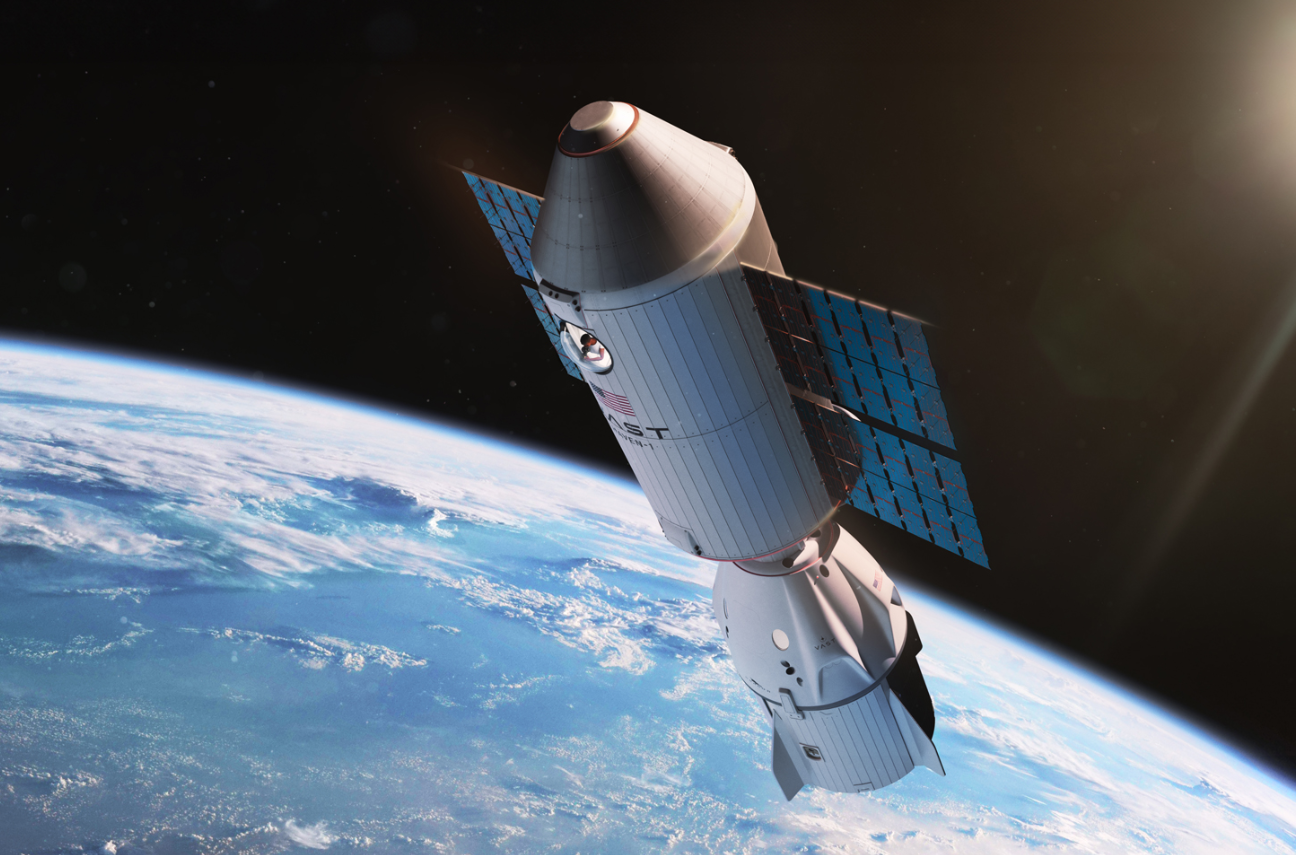
In just the last week, Vast announced that its Haven-1 space station has completed welding, meaning the main structure is done. With that step finished, it’s now ready for testing before integration and finally a launch. Currently, the company is aiming for May of next year to put the station in orbit.
If successful, that would ensure it’s the first commercial space station and open future opportunities to launch additional segments and expand it over time. In addition to the main structure, there’s also been progress on life support systems and relevant hardware. Here I will go more in-depth into the recent station progress, final steps, what to expect, and more.
Welding Complete
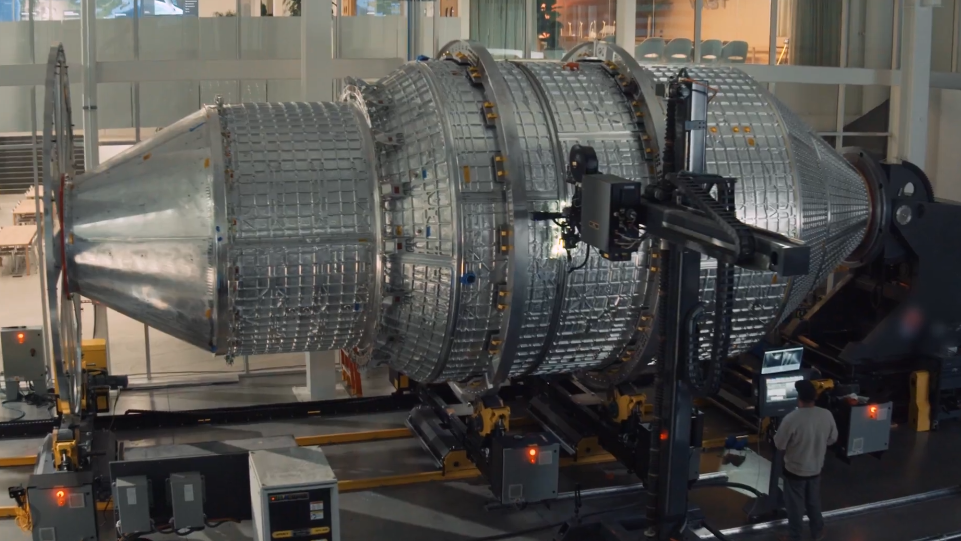
Vast released a new video showcasing the main station structure. Starting back in May, they began making circumferential welds on different parts of the station. In total, there were 10 of these welds leading to a complete flight hull. Vast tweeted saying, “Haven-1, the world’s first commercial space station and America’s next space station, is now fully welded and will soon begin testing ahead of integration.”
In other words, in the near future, we can expect Vast to begin bringing all of the station’s systems together to create an actual viable station. Importantly, in this stage, they will test everything from the station’s structural integrity to the various life support systems and hatch. According to the company, pre-launch activities are set to begin in April 2026. In that case, they’ll prepare for vehicle integration and then finally a launch in May, assuming everything goes according to plan. This gives the company between now and April of next year to turn the current core flight hull into a sealed and complete station ready to support future missions in orbit. The timeline is ambitious, but Vast is confident they will be ready by the deadline.
Back in 2023, Vast signed a contract with SpaceX to have the Falcon 9 rocket launch the first Haven-1 module and station. Apart of this deal, SpaceX and the Dragon spacecraft are expected to bring the first crew to the station not long after its operational.
When complete, Haven-1 will be a single-module orbital space station with the capability to host four crew members for up to 40 days and hold up to 300 kg of total payload mass. Vast notes that the station accommodates crew and cargo in a microgravity, pressurized environment, and has the ability to spin end-over-end while uncrewed, simulating Lunar gravity (⅙ g). Payloads hosted on Haven-1 will be installed in Haven-1 Lab using interfaces modeled after industry-standard, pressurized payload accommodations. Those accommodations will provide power, data, and thermal management. Once in place, Haven-1 will operate in a 425 km circular orbit, and is designed for a 3-year on-orbit lifetime.
Last year, in 2024, the company built a qualification article that they’ve been using since then for testing. For example, in May, they showcased the test article in a vertical configuration to validate the overall design of the station. The test stand features pressurization using dry nitrogen, 36 hydraulic actuators simulating localized launch forces, and 64 strain gauge channels, plus pressure and temperature sensors inside and outside the vehicle. All of which were used to confirm the safety and strength of Haven-1.
While the main structure of the station is important, it also involves a lot of different systems to make it habitable. Not long ago, NASA partnered with the company and completed a test of a critical air filter system. Testing confirmed the system can maintain a safe and healthy atmosphere for all planned Haven-1 mission phases. In reality, over the past few months, the company has been testing a handful of systems.
In just this month alone, they tested fans that will provide ventilation for the various environmental control systems to support the crew. These systems’ functions range from circulating fresh air through the station to cooling payloads. They also successfully tested Haven-1’s payload power module. Specifically, the power module, built in-house, was tested to NASA standards and demonstrated that it can support scientific samples transported at temperatures between -95°C and +10°C.
In addition to all that, Vast actually plans to launch a small spacecraft into Earth orbit relatively soon in order to properly test some of the systems that will eventually be used on the actual station. Named Haven Demo, it will test systems including power, software, guidance and control, propulsion, radios, ground stations, mission control, and more. In the next few months, we should see this spacecraft launched, at which point the company can begin gathering data and making any changes, if necessary, to the hardware that will be used on the actual station.
In terms of the timeline, back in 2023, the company announced a launch date of August 2025. This was eventually pushed back to the current date of May 2026, after the company began work and got a better understanding of the timeline. Something to keep note of as they push for a launch next year.
Haven-1 Design
Not long after the station is in position, Vast crewed missions will then launch in a Crew Dragon spacecraft and rendezvous and dock with Haven-1. Renders showing the two docked together highlight the size of the station, which by itself isn’t significantly bigger than Crew Dragon.
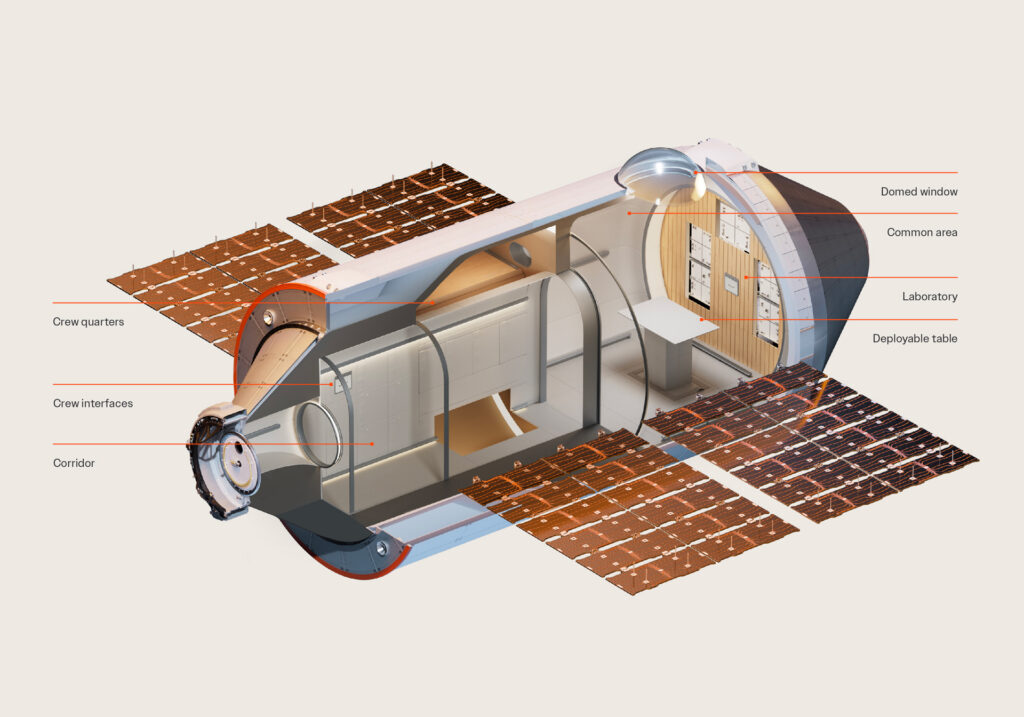
The Station’s height is 10.1m with a 4.4m diameter. The total pressurized volume is 80 cubic meters, but the habitable volume is 45 cubic meters. After docking, you would enter a hallway that leads to the main room. This initial corridor is the area where crew equipment is stored on the station. Some of the items stored here would include food, water, tools, cleaning supplies, and safety equipment.
Besides storage, there would also be crew interfaces to monitor various systems, tracking location, external camera feeds, etc. The last main part of this initial corridor is the crew quarters.
Going into the main room, there would be a deployable table in the center, which goes flush with the floor when not in use. There’s also a large 1.1m domed window for observation. Finally, at the very back wall is what they call the Haven-1 lab. This section consists of 10 payload slots and is meant to be a collaborative space for companies and governments to perform research.
Moving to the exterior of the station, multiple deployable solar panels produce 1.1 kW of power each, for a total power of 13.2 kW. As for the station’s primary structure, it’s a welded aluminum alloy. They note that the docking port is very similar to that of the International Space Station and connects it to the Dragon spacecraft.
With it only planned to be operational for 3 years, there’s a limited amount of time for crewed missions. In fact, the company has already thought out its future lifecycle and plans 4 missions over the course of those 3 years. This involves an initial commissining phase of 45 days, followed by the first mission that lasts two weeks. We then get 6-9 months of uncrewed operations followed by another two-week crewed mission, with that pattern continuing until the end of the station’s life.
Interestingly, this first station is just a stepping stone when looking at the company’s future plans. Named Haven-2, Vast wants to build a much larger and more permanent space station with initial modules launching in 2028 and expanding until 2032.
It will start with one module, with additional modules launching every 6 months until the first 4 have been connected. At that point, in 2030, they would launch the Haven Core, a much larger 7m diameter central station section. The four existing modules would then disconnect and reorient themselves on either side of the new core. Finally, over the next two years, four more sections would be launched, creating a total crew volume of 500 cubic meters. For comparison, the ISS has a habitable volume of around 388 cubic meters.
Besides its size, some of the notable additions would be a 3.8m window and external payload facilities using a large robotic arm. In total, the launch mass of the completed station would be 282,000 kg.
Before that, however, the company needs Haven-1 to be successful, and ideally, launch on time. Beyond recent physical progress, the company has also been signing new payload partners. In April of this year, they announced Japan Manned Space Systems Corporation, Interstellar Lab, and Exobiosphere as the latest partners for the Haven-1 lab.
The first company will install a multi-purpose payload facility that accommodates microgravity experiments and small payload modules. These sub-payloads include devices for a process for developing advanced optical materials, interfaces for commercial merchandise items, and many other applications.
Interstellar Lab will add Eden 1.0, a plant growth unit designed to conduct research on plants in a microgravity environment on a space station. Installing it inside the lab is meant to allow the company to conduct research that will measure and understand the impact of microgravity on plant growth.
In relation to these partners, the CEO of Vast was quoted saying, “We are honored to welcome our new partners to the Haven-1 Lab—an essential step toward building a thriving ecosystem for science, innovation, and collaboration in space. These partnerships reflect a growing global recognition that microgravity is not just a research environment, but a catalyst for transformative breakthroughs. With Haven-1, we aim to redefine what’s possible in biotechnology and pharmaceuticals—accelerating discovery, enhancing safety, and unlocking new frontiers for life on Earth and beyond” he said.
While the schedule is tight, over the next few months, we should get a much better idea of exactly how much more work the company has and its impact on the launch timeline.
Conclusion
Vast has officially completed the primary structure weld of the Haven-1 space station. Between now and April, the company will build up and test all the systems in preparation for vehicle integration. If all goes well, we will see it launch in May of next year, making it the first commercial space station.