In the last few days, the Federal Aviation Administration (FAA) posted a Draft Tiered Environmental Assessment regarding Starship operations. Specifically, it has to do with airspace closures as a result of new Starship trajectories and catch attempts.
Up until now, we’ve seen Starship upper stages splash down in the Indian Ocean during successful flight tests. Soon, however, SpaceX plans to put the upper stage in orbit and attempt a return to launch site and catch, a mission milestone that requires approval from the FAA. Here I will go more in-depth into the new assessment, aircraft hazard areas, approval timelines, and more.
Assessment Overview
For context, SpaceX is seeking to obtain a modification of its existing vehicle operator license from the FAA to account for updates to Starship-Super Heavy operations at the Starbase launch site in Texas. This specific document that the FAA just released analyzes those updates, which include new information related to airspace closures for additional launch trajectories and Starship Return to Launch Site mission profiles at the Boca Chica Launch Site.
In other words, SpaceX wants to start attempting different, more advanced flight profiles in the relatively near future. One example is orbital flights. The document is quoted saying, “orbital launches would primarily be to low inclinations with flight trajectories north or south of Cuba that minimize land overflight. SpaceX currently launches from the Boca Chica Launch Site through the Straits of Florida, north of Cuba, for a suborbital trajectory. Additional launch trajectories are needed to support orbital trajectories for Starship for Return to Launch Site mission profiles.”
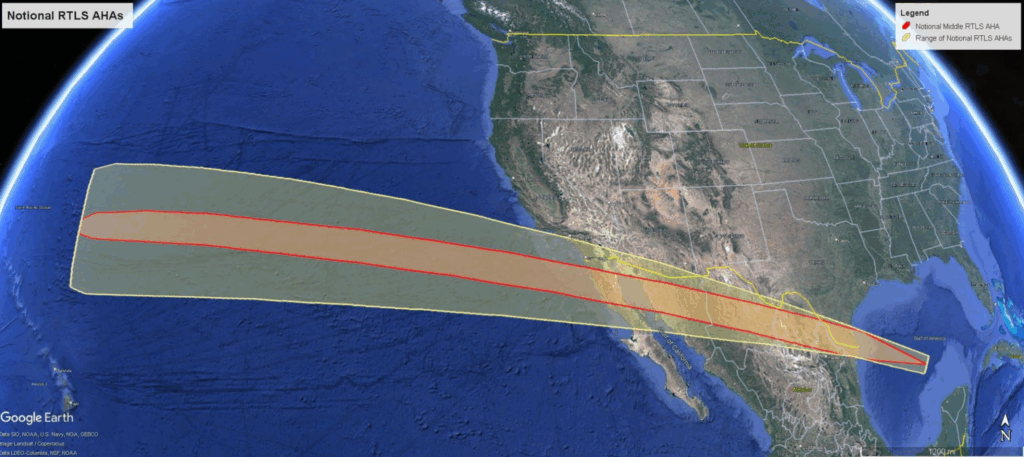
Looking at one of the figures provided, it shows both possible launch trajectories and the corresponding Super Heavy return AHAs or Aircraft Hazard Areas. A part of the assessment, they looked at the impact these launches could have on commercial aircraft. They determined that the launch and Super Heavy booster landing AHAs could affect a minimum of 10 commercial aircraft per hour, during the lowest period of midnight hours, or up to a maximum of 200 commercial aircraft per hour, during peak daily travel periods.
They then look at Starship’s return to the launch site, which is even more significant. In a statement, they say, “Starship Return to Launch Site operations would impact air routes extending westward from the Boca Chica launch site through Mexico and portions of Texas and California, covering approximately 3,700 nautical miles. Starship reentries would impact air routes extending from the Pacific Ocean, Southern California, across Mexico, Southern Texas and extending into the Gulf of America. AHAs may necessitate the closure of dozens of coastal and deep-water oceanic airways over the Pacific Ocean and Gulf, requiring the rerouting of aircraft to avoid the AHAs.
The figure provided puts in perspective how massive this area is. The Pacific Ocean and Mexico are the two main places affected. Obviously, SpaceX would be aiming for the upper stage to survive reentry in one piece, followed by a controlled catch. That being said, we’ve seen from past flights, particularly early in the mission profile, the upper stage being lost and creating massive debris fields requiring aircraft to be redirected or go into holding patterns.
In this case, even if the flight goes perfectly, it will still have an impact on aircraft in the area. They go on to highlight that “The Starship Return to Launch Site AHAs could affect up to a maximum of 200 commercial aircraft per hour, for all potential AHA’s within the range depicted, during peak daily travel periods during daytime hours. The April 2025 Tiered EA assumed that up to 22 Starship reentries would occur during the day (7:00 AM to 10:00 PM), and no landings would occur during nighttime hours (10:00 PM to 7:00 AM). A total of up to 4,400 flights per year could be affected by the Starship Return to Launch Site AHAs.” The table shows a range of the approximate number of commercial aircraft impacted per hour and per year for the total operations proposed.
A big part of the assessment went over the concern of failures and the resulting debris field. They mention, “A launch could result in debris and hazardous materials being distributed below the AHAs. The size of AHAs can grow or shrink as reliability is either decreased or increased with results and analysis from each launch. If any anomalies occurred during the operation, SpaceX would respond to all accidental releases of polluting substances quickly and implement appropriate cleanup measures in accordance with applicable laws to minimize impacts to the environment.”
“A near-surface ship explosion or a high-altitude breakup of the ship would create a debris field comprised of mostly heavy-weight metals and some composite materials. If deposited in the water, most of these materials would sink rapidly through the water column, while some items may stay buoyant on the surface or suspended in the water column before sinking towards the seafloor. Starship is constructed primarily of stainless steel, which is non-toxic and inert. Other debris includes thermal heat tiles composed of silica, which has similar properties to glass and is highly resistant to degradation” they said.
In terms of timeline and approval, public comment is open and will be until October 20, with a public meeting scheduled on October 7. All of which is in preparation for the final environmental assessment.
As for SpaceX, the company still has a few launches left at least before they are ready for a ship catch attempt. The next launch is Flight 11, the final flight using a Starship V2 variant. Because of that, we can expect a similar flight profile as the last launch, with the upper stage attempting reentry and splashdown in the Indian Ocean. Next is Flight 12 with a significantly upgraded V3 rocket. They won’t attempt a ship catch on that first flight, so the earliest opportunity would be Flight 13. Schedule-wise, that would put a catch attempt closer to early to mid-2026, assuming things go very well. Elon tweeted saying, “Starship catch is probably flight 13 to 15, depending on how well V3 flights go.” The more successful the fights, the sooner we could see a catch attempt.
Currently, SpaceX is preparing for an increase in Starship launches. A big part of this has to do with launch infrastructure around the country. As part of the process to bring Starship launches to Florida, SpaceX has proposed clear areas for the various Starship vehicle configurations and operations. We even got news confirming that the company was working on a transport ship to move Starship stages from Starbase to Cape Canaveral. In a long update from SpaceX, they went over some of the work being done and the goal as they prepare for more launch opportunities and locations.
In a statement, they said, “Ultimately, increasing launch cadence and launch capacity is not a zero-sum game. SpaceX and the federal range operators have proven this with the Falcon rockets, which have shown the ranges can accommodate high cadence launch rates, including launches every day for several days in a row. With appropriate planning, coordination, deconfliction, and modernized safety procedures based on data, America’s spaceports can accommodate many flights from multiple providers on a continuous basis. Coordination across all providers and our government counterparts is the primary enabler of moving rocket launches into airport-like operations.”
Relevant to the new FAA assessment they mention, “During Flight 10 from Starbase, FAA reopened all affected airspace within 10 minutes, with some portions reopening within 7 minutes, and there was no meaningful disruption to air traffic due to effective prior coordination. We are confident in this partnership to continue to efficiently integrate these operations into the National Airspace System (NAS). As we have demonstrated with Falcon operations, aircraft hazard areas (AHAs) undergo significant size reductions as a vehicle builds flight heritage. For example, we have reduced Falcon 9 hazard areas for Starlink missions by approximately 66 percent since 2022. The AHAs and accompanying descriptions published within the recent Launch Complex 39A draft Environmental Impact Statement (EIS) are extremely conservative by nature and are intended to capture a composite of the full range of worst-case outcomes, but not any single real-world operation. SpaceX fully anticipates actual, implemented AHAs will be both far smaller in geographic scope and far shorter in duration, validated by the robust flight data and heritage we are building from Starbase” they said.
Another focus has been the possible impact on other launch sites and rockets in the Cape upon Starship’s arrival. Graphics provided by SpaceX highlight proposed clear areas for Starship launch sites in Florida, designed using data from years of research testing the yield of LOX/Methane rockets. They pointed out, “With this new data and proposed methodology for evaluating blast danger areas for LOX/Methane rockets, SpaceX is confident that Starship operations will not disrupt other launch operators at Kennedy Space Center or Cape Canaveral Space Force Station (CCSFS).”
So far in the two-plus years Starship has been launching, the rocket has lifted off 10 times in total. As we get close to Starship V3, along with more capable and more launch infrastructure in general, the frequency of launches is expected to increase a lot. That being said, SpaceX is confident that this up in cadence will only make the vehicle more reliable and, in a way, reduce its impact near its launch sites and under launch trajectories.
Conclusion
SpaceX is working with the FAA and trying to get approval for Starship catch attempts. We’ve seen the booster return to the launch site, but in only a few flights, we could see the upper stage placed into orbit before reentering the atmosphere and attempting a tower catch.