
Not long from now, Axiom Space is expecting the first module of its commercial space station to arrive in Houston and begin launch prep. Over the last year or so, the plans have changed quite a bit regarding both the design of the station and its interaction with the International Space Station.
Currently, the plan is to launch and dock the first module to the ISS. After that, instead of all four segments, before the second module arrives, the initial segment will detach and start operating independently. A big part of this change of plans has to do with the fact that the first station segment was meant to launch over a year ago, in addition to the ISS nearing retirement. Here I will go more in-depth into the station’s progress, the change of plans, what to expect in the future, and more.
Station Progress
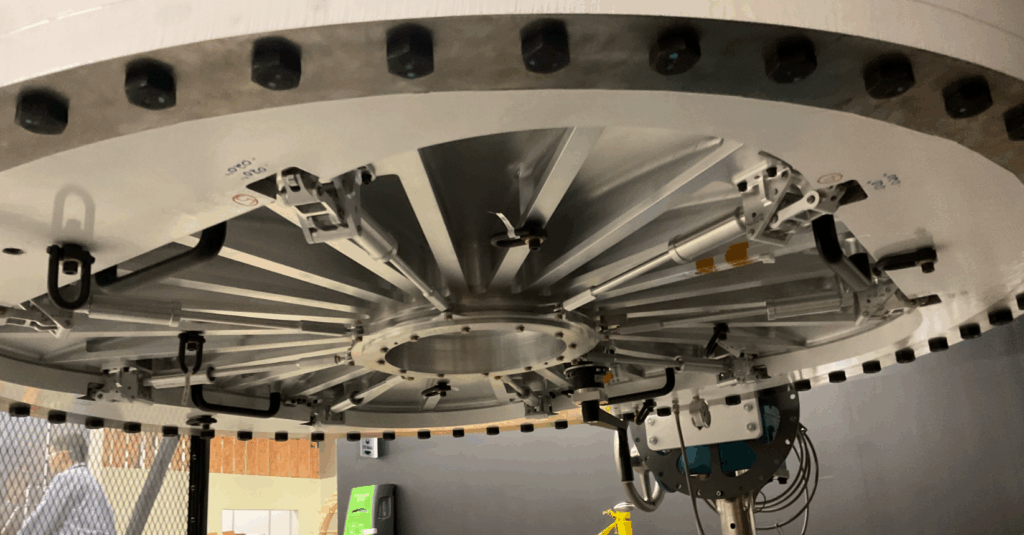
Earlier this month, Axiom posted a new video of progress on the Station’s Payload, Power, and Thermal module pressure vessel, the first segment, which will dock to the ISS. They just need to connect the aft and forward sections, followed by completing flight certification tests. Besides its core construction, it will also feature 2 hatches. Axiom confirmed that those hatches have been finished, tested, and shipped to the factory for installation. However, they are currently working to repurpose various station segments to account for mission changes.
For context, the first module would have likely been done and shipped to the U.S. much sooner had Axiom and NASA not changed the plans. Originally, Axiom wanted the first module to launch in 2024, and its primary purpose was to provide crew quarters. Then in 2025, the second segment connects, providing additional space for crew. In 2026, we would see the lab module, featuring an added viewing room and more space. Finally, in 2027, the crucial power module would attach, completing the station and allowing it to separate from the ISS and become an independent commercial station.
As time went on, it became clear that this schedule and plan wasnt going to work. At that point, Axiom and NASA decided to have the first module become what they call the Payload, Power, and Thermal Module. Instead of crew quarters, the modules’ focus, as the name suggests, is power, meaning they could separate just this module and have the station support itself.
In a statement from NASA, they commented, “Under the company’s new assembly sequence, the Payload, Power, and Thermal Module will launch to the orbiting laboratory first, allowing it to depart as early as 2028 and become a free-flying destination known as Axiom Station. In free-flight, Axiom Space will continue assembly of the commercial destination, adding the Habitat 1 module, an airlock, Habitat 2 module, and the Research and Manufacturing Facility.”
The Commercial Low Earth Orbit Development Program manager at NASA said, “The updated assembly sequence has been coordinated with NASA to support both NASA and Axiom Space needs and plans for a smooth transition in low Earth orbit. The ongoing design and development of commercial destinations by our partners is critical to the agency’s plan to procure services in low Earth orbit to support our needs in microgravity” she said.
The reality is they were running out of time, and it became clear that the fourth module apart of the original plan, wouldn’t have launched before the ISS retired.
To build this new module, they are repurposing various sections of the original station modules. Specifically, it’s utilizing structural elements from AxH1 and AxH2. Elements from these modules are already underway and will be back-filled – AxH1 being the priority to enable its rendezvous with PPTM once separated from the International Space Station. The CTO at Axiom was quoted saying, “Because we’re reusing 85% of the stuff, and in some cases simplifying because we won’t need all of the life support for the first module, we can still launch that first module”.
Even with current progress and the first segment not far from completion, the company has stated that the first launch will happen no earlier than 2027.
Between now and then, the company needs more time for construction and to work on the other systems core to the station’s operation. For example, Axiom’s propulsion team recently started its testing of the eighth version of Axiom Station’s thrusters, which they call Mark 8. When they’re done, they’ll install 32 thrusters on the first module. Earlier this month, the FAA also officially granted a favorable payload determination for the Payload, Power, and Thermal Module. Now Axiom just needs to finish it and prepare for a launch.
ISS Connection
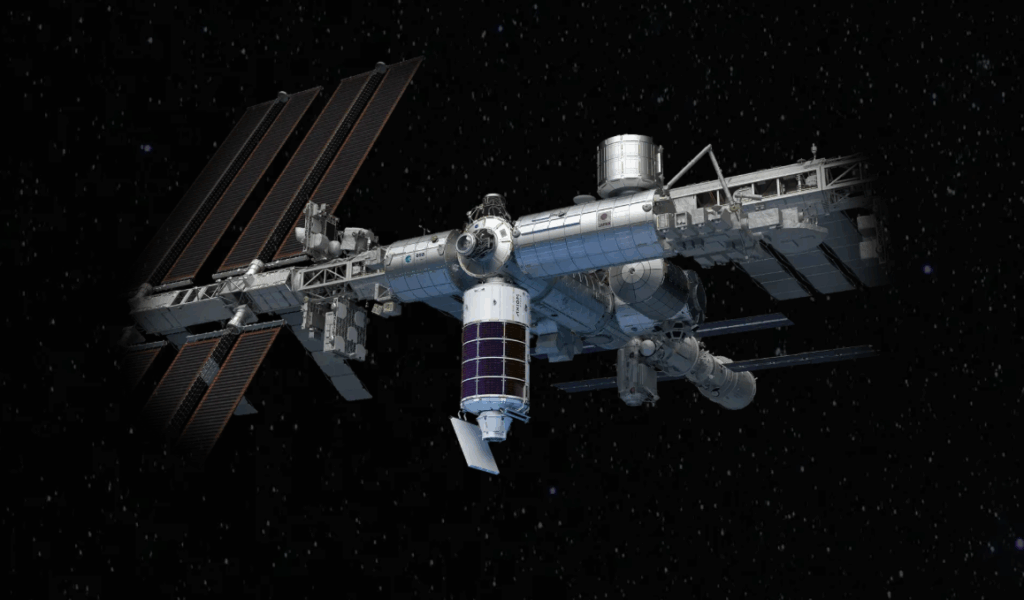
The original plan to connect to the ISS over the course of years meant it could use the station to support it as it built up over time. With the changes, it begs the question of what purpose does it even serve if Axiom plans to separate after attaching just a single module.
On Axiom’s website, they are quoted saying, “Payload Power Thermal Module berths to the International Space Station and facilitates the transfer of critical infrastructure and payloads.” In other words, with the ISS set to retire not long after, we could see valuable equipment moved from the station onto Axiom’s module. In relation to this, it’s said that the new module will have significantly more storage than the original Hab One, meaning more space for equipment being moved from the ISS.
Originally in 2020, NASA awarded Axiom a firm-fixed price, indefinite-delivery, indefinite-quantity contract with a maximum potential value, inclusive of options, of $140 million over an up to seven-year ordering period consisting of a five-year base period and a two-year option. A lot of time has passed since then as the company still tries to get the first module complete.
Looking at the revised plan, there are five modules in total. After the Power module, the second segment is called Hab 1. This module will connect right after the first separates from the ISS. It provides four crew quarters and will also enable research and manufacturing capabilities. Next is a specific airlock segment. This module would add extravehicular activity support in conjunction with Axiom’s spacesuit. The fourth launch would be Hab 2, adding more crew quarters. Finally, they would send the research and manufacturing or RMF module. Besides space for science, it would also include a massive viewing room.
While there have been a lot of delays, progress is still being made. Earlier this year, Axiom completed a successful execution of the first simulated mission of the Payload, Power, and Thermal Module (PPTM). The scenario involved an approach initiation burn to guide PPTM toward the International Space Station (ISS) for rendezvous and capture.
In a statement, they said, “Conducted within Axiom Space’s Mission Control Center-A (MCC-A), this effort brought together across-disciplinary team of simulator engineers, user interface display developers, and the Mission Services flight control team to integrate previously separate efforts into a cohesive operational framework. The team used prototype displays for guidance, navigation and control (GNC), propulsion, communication, and power systems.”
“This demonstration served as a critical step in aligning the infrastructure and personnel necessary to prepare Axiom Space for future space station flight operations. The primary objective was to establish and test the flow of real-time data from the simulator to vehicle displays within the MCC-A infrastructure. A secondary objective focused on exercising these tools in a controlled environment, allowing an experienced flight control team to assess the tools’ effectiveness” they said.
Even with various progress, Axiom has a serious deadline. At the conclusion of the International Space Station Program, the station will be deorbited in a controlled manner to ensure avoidance of populated areas on Earth. Not long ago, NASA announced SpaceX was selected to develop and deliver the U.S. Deorbit Vehicle that will provide the capability to deorbit the space station.
By now, the International Space Station has more than 23 years of continuous human presence aboard the microgravity laboratory, with assembly missions starting in 1998. The agency was quoted saying, “Throughout the years, NASA and its international partners have worked together to operate, maintain, and upgrade parts of the station. The technical lifetime of the station is limited by the primary structure, which includes the modules, radiators, and truss structures. The lifetime of the primary structure is affected by dynamic loading (such as spacecraft dockings/undockings) and orbital thermal cycling. NASA has committed to fully use and safely operate the space station through 2030, as the agency also works to enable and seamlessly transition to commercially owned and operated platforms in low Earth orbit.”
With Axiom only launching a single segment, even if there are more delays, they should still have time to complete that part of the mission. Unfortunately, in the grand scheme of things, it means they will have a much smaller and less capable station than the original plan by 2028. Over the next few months, we should hear more regarding that initial module’s progress and its eventual shipment to Houston.
Conclusion
Even though plans have changed and parts of Axiom station have been delayed, progress is continuing on the first module. Currently, the company is aiming to launch that module no earlier than 2027, meaning there is still quite a bit of time left before we see the station dock to the ISS.