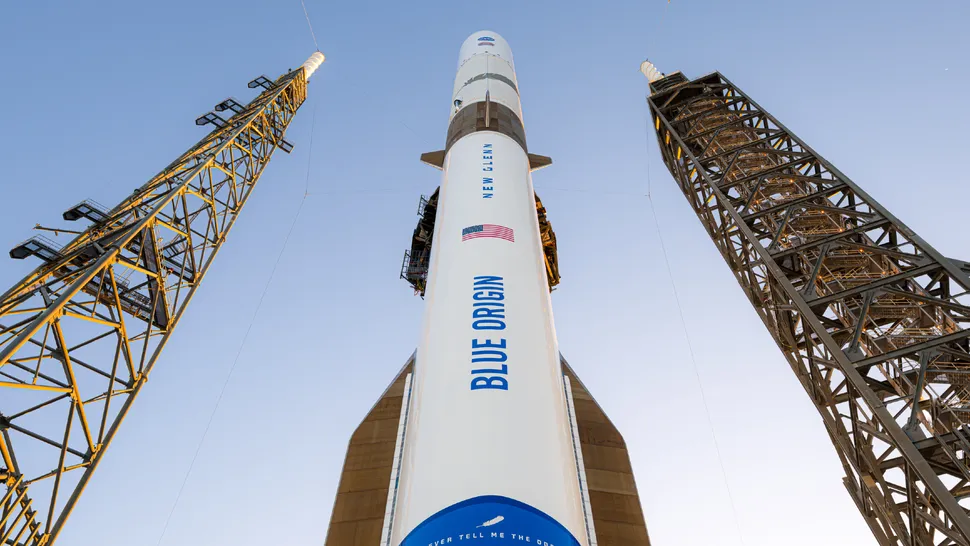
Earlier this morning, Blue Origin confirmed that the NG-2 mission, which was scheduled to launch today, was being postponed due to space weather. Specifically, NASA is concerned about highly elevated solar activity and its impact on the two ESCAPADE spacecraft.
Unlike the last delay, which had to do with normal weather concerns and clouds in the area, there isn’t a new launch date set as teams look for a better opportunity. Here I will go more in-depth into the delay, impact on ESCAPADE, when we can expect a launch, and more.
Solar Storm
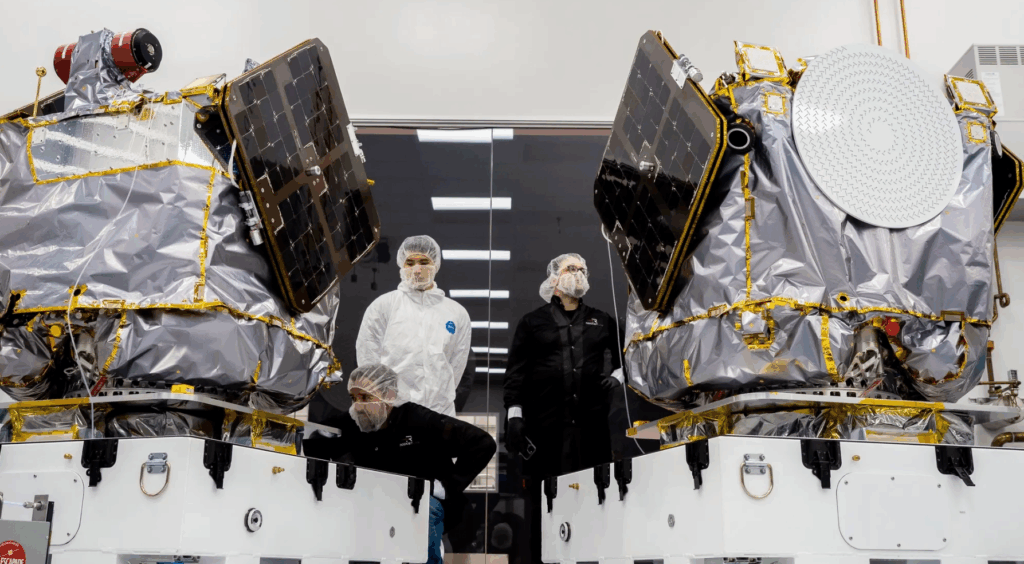
A few hours ago, Blue Origin tweeted saying, “NG-2 Update: New Glenn is ready to launch. However, due to highly elevated solar activity and its potential effects on the ESCAPADE spacecraft, NASA is postponing launch until space weather conditions improve. We are currently assessing opportunities to establish our next launch window based on forecasted space weather and range availability.”
When they mention solar activity, they are referring to extreme solar storms or coronal mass ejections from the sun. Coronal mass ejections (CMEs) are large expulsions of plasma and magnetic field from the sun’s atmosphere, the corona. They take around 15 hours up to a few days to reach Earth, and when they do, their impact can be pretty significant.
Yesterday, on the 11th, the aurora borealis was visible as far south as New Glenn’s launch pad in Florida. In regard to spacecraft and a launch, the impact can be significant and definitely warrants a delay. During a solar storm, they can increase the amount of drag a rocket and satellite, in particular, are exposed to.
For example, back in 2022, SpaceX launched a routine Starlink mission with 49 satellites during a geomagnetic storm. The satellites were commanded into a safe mode, but increased atmospheric drag prevented them from leaving safe mode to begin maneuvering from the low deployment altitude to an operational orbit. Only a few days later, 38 of the satellites had reentered the atmosphere while the remaining 11 continued to raise their orbits. In other words, the increased drag was responsible for the loss of about 80% of them.
In the case of Blue Origin and NG-2, the ESCAPDE mission features two spacecraft headed to Mars. The trajectory consists of a ~1-year, Earth-proximity phase before returning to a low-altitude perigee for a Trans-Mars Injection (TMI) engine burn. This eventual burn sends Blue and Gold on their way to Mars. Importantly, the initial deployment and trajectory would be impacted by the current space weather. So much so that NASA has postponed the launch to ensure the payloads make it to their destination.
Unfortunately, as they work to find the next opportunity, they have to balance space weather, normal weather, and also the FAA. Recently, the FAA temporarily restricted commercial launches to address safety risks and delays presented by air traffic controller staffing constraints.
The agency is quoted saying, “This Order reduces or temporarily prohibits certain operations in the navigable airspace to ensure the safety of aircraft and the efficiency of the National Airspace System (NAS). Commercial space launches and reentries will only be permitted between 10:00 p.m. and 6:00 a.m. local time.” This isn’t ideal for Blue Origin as it only complicates things further.
That being said, the company and agency have already been working together to get the most recent launch date available. There are exceptions to the rule in certain instances.
In another statement, the FAA mentions, “The FAA may modify or withdraw any provision in this Order on its own or on application by any carrier for good cause shown. In particular, the FAA will continue to monitor data on NAS operations and performance and will amend this order as appropriate to ensure continued safety and efficiency of the NAS. Once funding is restored and the FAA has confidence the stress in the system has adequately decreased, the FAA expects to roll back operational restrictions required by this order to restore normal operations” they said. With this in mind, it could also sort itself out in the near future.
As for the solar storm, current reports show it lasting at least a few more days on both the 13th and 14th. The National Oceanic and Atmospheric Administration said that “Geomagnetic storm conditions are currently at G3 levels (Considered Strong) after reaching G4 (Severe) levels earlier. They go on to say, “The nature of the current disturbance means that G4 conditions with a chance for higher levels are still possible. The threat is expected to remain throughout the day as another disturbance is expected to arrive on the 12th” they said.
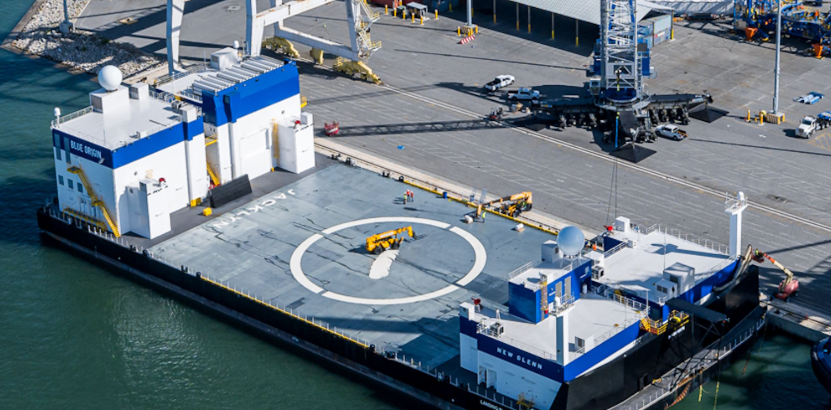
You then have to consider normal weather conditions. This applies to both the launch pad, where the rocket lifts off, and also the landing barge, Jacklyn, a few hundred miles offshore. The launch today had pretty favorable conditions with a moderate rating on offshore landing weather.
The first launch attempt a few days ago, however, was delayed due to weather. On the 9th, Blue Origin tweeted saying, “Today’s NG-2 launch is scrubbed due to weather, specifically the cumulus cloud rule. We’re reviewing opportunities for our next launch attempt based on forecasted weather.” This is a safety regulation that prohibits launches when certain types of clouds are present, primarily because they can act as lightning triggers, among other issues.
All things considered, right now is simply not the best time to be trying to launch a rocket with all the different regulations and weather events going on. Fortunately for Blue Origin, in just a few days, a lot of these issues could be resolved, meaning a launch in the near future is realistic.
It’s also worth mentioning that because this is a Mars mission, there is somewhat of a set window where they need to launch. The alignment of Earth and Mars constrains ESCAPADE’s windows of launch opportunities to the Red Planet. This means that small schedule changes can result in months-long delays in launch. Something both Blue Origin and NASA are well aware of.
Part of the journey to Mars, there are several trajectory correction maneuvers (TCMs), with the two spacecraft arriving at the red planet around September 2027. From here, Mars Orbit Insertion puts Blue and Gold into a large capture orbit. They spend the next few months (late 2027 and early 2028) reducing and synchronizing the orbits of Blue and Gold. Finally, in late Spring 2028, they would begin their science mission, which consists of multiple campaigns.
If successful, ESCAPADE will analyze how Mars’ magnetic field guides particle flows around the planet, how energy and momentum are transported from the solar wind through the magnetosphere, and what processes control the flow of energy and matter into and out of the Martian atmosphere.
Flight Profile
When New Glenn does eventually lift off, it should be a pretty eventful launch. Blue Origin released the full flight profile, which gives us an idea of what to expect. At T – 30 seconds, the water deluge system turns on, and the engines ignite with 5.6 seconds left on the clock. It then lifts off and will start accelerating.
Not long after clearing the tower, it will gain speed and altitude, reaching Max Q a minute and a half in. At T + 3 minutes, we’ll first see MECO or main engine cut off, followed shortly after by stage separation and then second stage ignition. Here, each of the two BE-3U engines generates 175,000 lbf (778 kN) of vacuum thrust.
Less than a minute after second stage ignition the payload fairings will be jettisoned. We then get a few minutes before the next mission milestone, and the start of the booster’s reentry process. At T + 6:48, 3 of the booster’s BE-4 engines will ignite apart of the reentry burn. The engines are expected to fire for 30 seconds, significantly slowing the stage. At T + 8:27, we’ll see the single-engine booster landing burn. That engine burn and mission milestone is expected to last around 42 seconds. If everything goes to plan, the booster will come into frame and slowly touch down on the Jacklyn barge.
After that, we get a few more engine shutdown and ignition sequences of the upper stage until around T + 30:00. The Blue spacecraft will deploy with Gold following it 30 seconds later. They will then turn on the Viasat demonstration with an official mission end time of T + 1:42:00.
While the main goal is deploying the payloads, Blue Origin really wants to land the booster. Dave Limp was quoted saying, “NG-1’s goal was clear: reach orbit, everything after that was a bonus. NG-2 builds on that with our primary goal to get Escapade safely to orbit and land the booster. What if we don’t stick the landing? That’s ok. We’ve got several more New Glenn boosters already in production” he said. Similar to the first launch, the booster is named Never Tell Me The Odds, in reference to the landing attempt. Last time the booster was lost during the initial engine ignition and reentry burn. Even if Blue Origin doesn’t successfully land on Jacklyn, they would at least like to make progress and get further than the last mission. Something we could see not long from now.
Conclusion
New Glenn was scheduled to lift off today; however, a solar storm forced the agency to cancel the mission and push it back. The increased drag could negatively affect the deployment of the satellites, which is the reason for the delay. While there isn’t a new official date yet, it likely won’t be too far in the future, and we should hear more in the coming days.