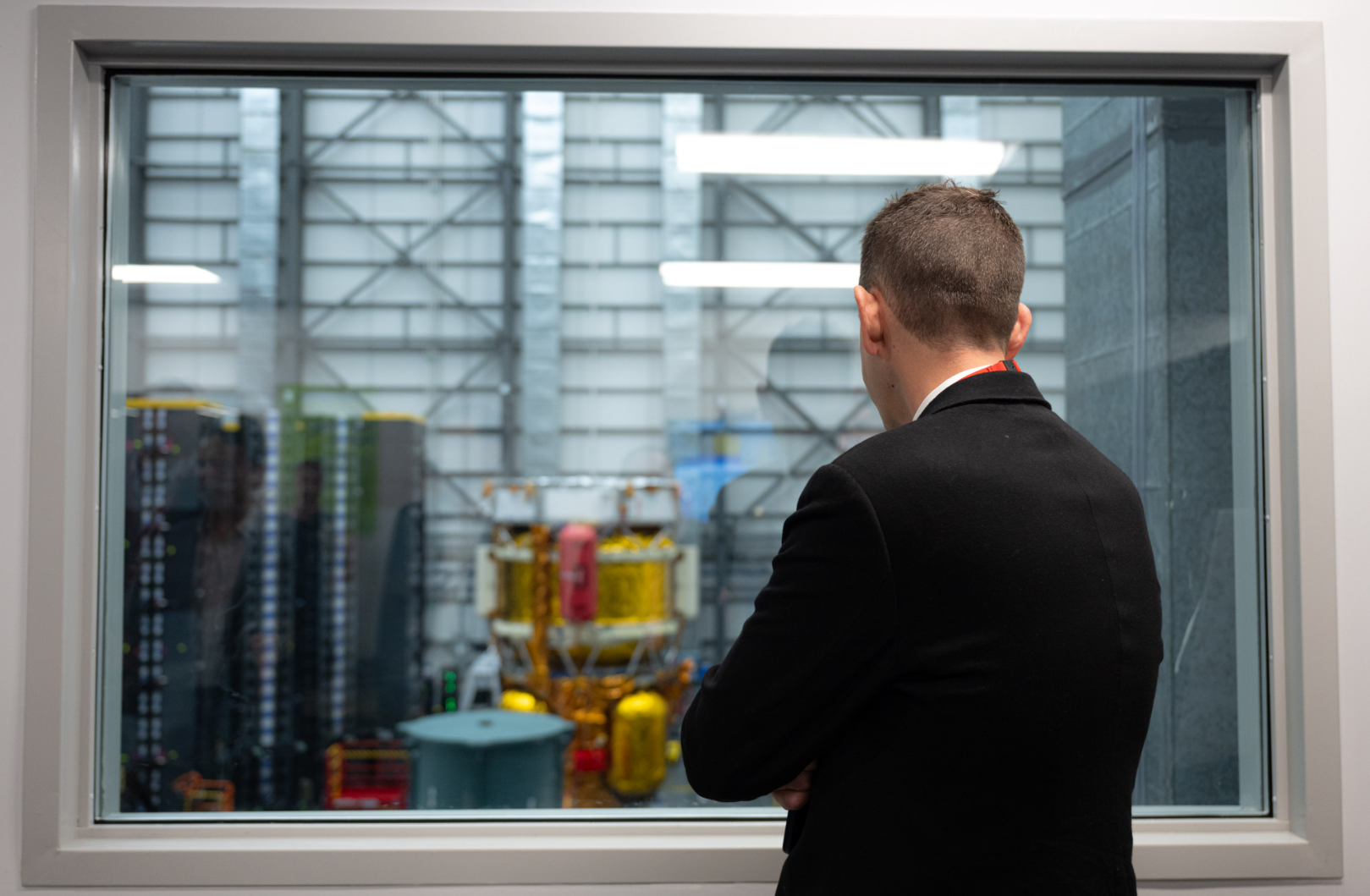
Over the past few months, Blue Origin has been sharing progressively more updates and information on its MK1 lunar lander as it nears completion. Slated to launch later this year, not only is the primary structure basically complete, but it’s already making its way down a test campaign to verify it’s ready for flight.
This includes acoustic testing, vacuum testing, and even engine integration. Once ready, the vehicle will be placed ontop of a New Glenn rocket and sent to the Moon for a planned landing at the lunar South Pole near Shackleton Crater.
MK1 Testing
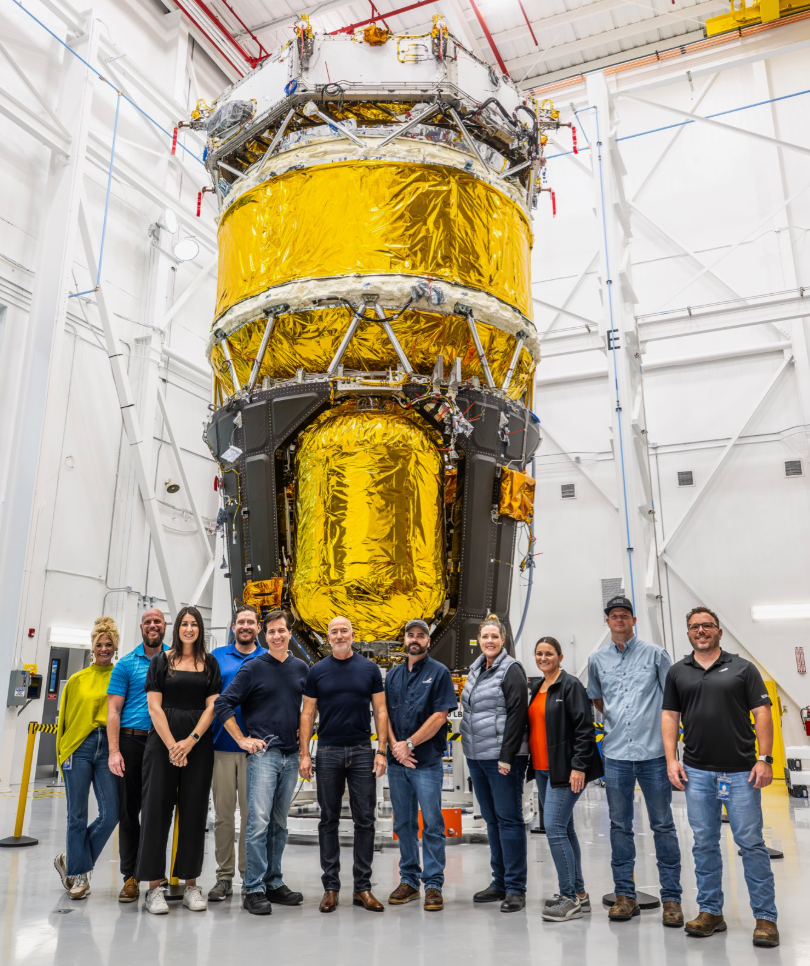
Starting a few months ago, in late November, Blue Origin began sharing images of MK1, which at that point was just about ready to begin its test campaign. One image in particular, which has some humans for scale in the foreground, helps put in perspective the size of this lander and especially its height. MK1 stands over 26 feet (8 meters) tall with around a 10 feet (3 meter) diameter. This is significantly larger than any of the recent lunar landers we’ve seen attempt landings on the Moon’s surface. For example, the Intuitive Machines Nova C lander, which attempted two landings so far, is around half the height of MK1.
Focusing back on its progress, it was then prepared for its first round of testing. In the second week of January, they completed direct field acoustic testing on the lunar lander, one of the few flight‑qualification milestones. Blue Origin CEO Dave Limp was quoted saying, “We surrounded the fully integrated lander with a ring of 34‑ft speaker towers to generate a near‑diffuse acoustic field, matching the New Glenn payload fairing environment at over 138 decibels overall sound pressure level.”
“MK1 ran in a flight-like configuration: tanks pressurized with helium and nitrogen, batteries powering the vehicle, with all critical avionics and guidance systems operating. 43 triaxial accelerometers measured response during a two‑minute exposure at protoqualification levels. Because the lander’s vibration environment is driven by acoustic loads, this test replaces traditional shaker-based vibration testing and more accurately represents ascent conditions,” he said.
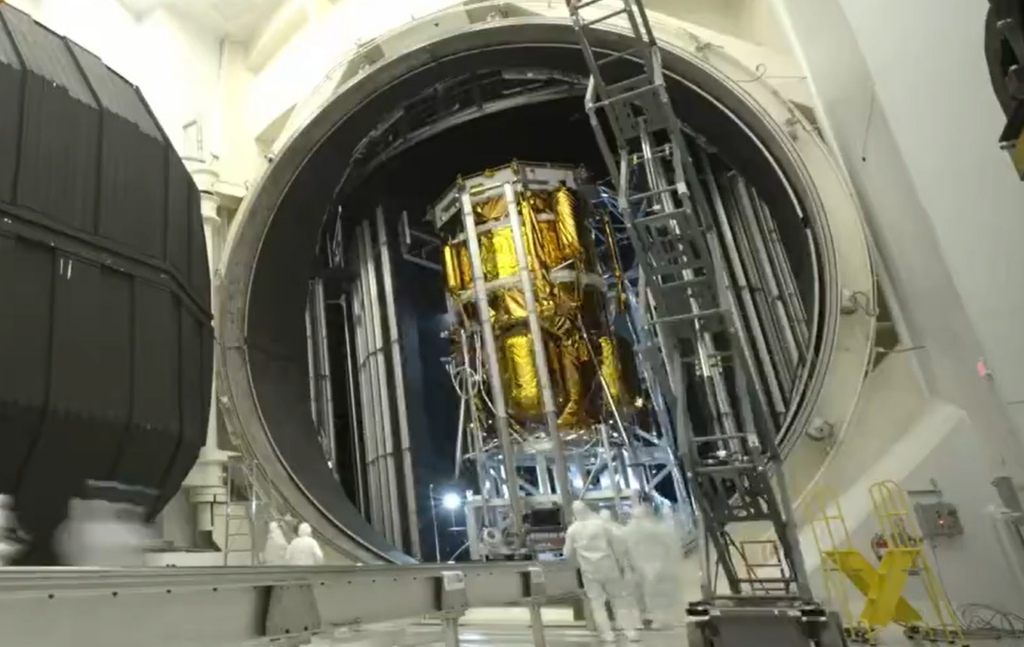
With that test complete and no issues arising, Blue Origin quickly packaged and shipped the lander to go from Florida to Houston, Texas. In fact, only about 5 days after the end of acoustic testing did the comapnry share images showing the lander packed up and beginning its journey. By early February, it had arrived at NASA’s Johnson Space Center. The reason it came all this way is that it’s the location of one of the world’s largest thermal-vacuum test facilities—where spacecraft are tested under the extreme cold, heat, and vacuum of space. Soon after, it was moved into the chamber for testing.
Dave Limp tweeted saying, “Endurance, our MK1 lunar lander, has entered Chamber A for approximately 11 days of TVAC testing to simulate the extreme thermal and vacuum conditions it will experience in space and on the lunar surface. Thanks to the team at NASA Johnson for the collaboration as we reach this critical step on our path to the Moon.” Based on its entry around February 13th, we can expect it to stay there until late this month.
More specifically, during these 11 days, teams will remove virtually all air to create a near-perfect vacuum that closely replicates space. MK1 will then be exposed to temperature extremes ranging from -50°C to +30°C. Dave Limp mentioned, “We’ll be performing both thermal balance and full mission testing at the hot and cold plateaus. This will prove that MK1 can maintain thermal equilibrium and perform its mission in space. MK1 joins the legacy of historic missions like Apollo and James Webb Space Telescope tested in this same chamber” he said. Assuming everything goes well, this will be another critical milestone now complete.
It’s worth noting that while the lander currently going through these tests is mostly complete, it’s still missing some core components. One big item in particular is the single BE-7 engine. From the different videos and images provided by the company, it looks like they haven’t installed it just yet. However, that’s likely the very next step once it completes more testing.
In December of last year, the BE-7 engine for Blue Moon MK1 completed acceptance testing. The company highlighted that “Two 290-second tests exposed the engine to its full range of thrust and mixture ratios to verify engine performance. The engine is now off to Florida for integration with MK1” they said.
The BE-7 is a dual-expander cycle engine that generates 10,000 lbf (44.5 kN) of vacuum thrust in space and is capable of deep throttling. The engines are being vacuum cell tested in a simulated space-like environment in the Air Force Research Laboratory at Edwards Air Force Base in California to prepare for lunar missions. Dave Limp added some context, pointing out, “The BE-7 engine is designed for 10,000 lbf and can throttle down to 2,000 lbf at any point during the mission. For MK1, we will use this throttle capability specifically for landing. It also operates at mixture ratios from 5.5 to 7.1 parts liquid oxygen per part liquid hydrogen, allowing us to optimize performance for different phases of the mission.”
The one other testing development that’s worth mentioning has to do with docking. For reference, Blue Origin is working on two Lunar Landers, MK1 and MK2. MK1 is primarily a pathfinder mission with cargo transport capabilities. However, future MK1 landers such as MK1 SN2 could start landing on the Moon with actual customer payloads. MK2 is a human landing system and is even larger than MK1. The goal is to test MK1 and then use the information gained for the next generation of landers.
With that in mind, a few weeks ago, Blue Origin showed off some docking tests with this future hardware. In a statement, they said, “Our Blue Docking System team successfully completed soft capture system testing at NASA Johnson’s Six-Degree-Of-Freedom Dynamic Test facility. This test completes a key milestone on our Commercial LEO Destinations (CLD) contract. The fully vertically integrated system will fly first on our Blue Moon MK2 Lunar Lander, then on Orbital Reef and future vehicles. This marks the first time we have confirmed the performance of our pressurized docking system in flight-like scenarios, meeting International Docking System Standard requirements.”
Launch Timeline
Originally, MK1 was supposed to launch on the third New Glenn flight. That third New Glenn mission is currently scheduled no earlier than late this month. However, MK1 isn’t ready yet, so AST Spacemobile is taking the slot on New Glenn flight 3. Realistically, that third flight won’t happen until March or April, based on the current progress.
With all this in mind, we might not see MK1 launch until the summer or the latter half of 2026. Blue Origin is working on trying to get as much New Glenn hardware ready as possible. Fortunately for them, the rocket is partially reusable. After the second mission and the successful landing of the booster, teams started working on refurbishing it and getting it ready for another flight. In the meantime, the third booster was already progressing. The plan is to use the refurbished booster from the second launch on NG-3. In a statement about the upcoming mission, Blue Origin said, “The mission follows the successful NG-2 mission, which included the landing of the “Never Tell Me The Odds” booster. The same booster is being refurbished to power NG-3.”
As for upper stages, months ago in December, they completed a GS2 static fire of serial number 4, representing the fourth one. The company has been adamant about trying to increase New Glenn’s launch cadence.
Looking at the next mission, AST SpaceMobile selected Blue Origin’s New Glenn launch vehicle in November 2024 as part of its launch campaign for its cellular broadband network. The Bluebird satellite network is meant to support commercial and government telecommunications applications, enabling users to remain connected as their devices transition between terrestrial cellular networks and space-based coverage, delivering broadband connectivity. Dave Limp said, “We’re proud to have AST SpaceMobile as our customer on NG-3. Our customers need a reliable, cost-effective launch vehicle, and New Glenn is purpose-built to serve their needs.”
This all comes in addition to upgrades planned for the New Glenn vehicle. Blue Origin announced a series of upgrades to New Glenn designed to increase payload performance and launch cadence, while enhancing reliability. The enhancements span propulsion, structures, avionics, reusability, and recovery operations, and will be phased into upcoming New Glenn missions beginning with NG-3.
One of the primary enhancements includes higher-performing engines on both stages. Total thrust for the seven BE-4 booster engines is increasing from 3.9 million lbf (17,219 kN) to 4.5 million lbf (19,928 kN). They highlighted that BE-4 has already demonstrated 625,000 lbf on the test stand at current propellant conditions and would achieve 640,000 lbf later that year, with propellant subcooling increasing the current thrust capability from the existing 550,000 lbf.
The total thrust of the two BE-3Us powering New Glenn’s upper stage is increasing from the original design of 320,000 lbf (1,423 kN) to 400,000 lbf (1,779 kN) thrust over the next few missions. BE-3U has already demonstrated 211,658 lbf on the test stand. They are confident that these enhancements will immediately benefit customers already manifested on New Glenn to fly to destinations including low-Earth orbit, the Moon, and beyond. Additional vehicle upgrades include a reusable fairing to support increased flight rates, an updated lower-cost tank design, and a higher-performing and reusable thermal protection system to improve turnaround time.
Conclusion
Blue Origin’s MK1 lunar lander is making progress and has already completed a few key test milestones. The lander is currently undergoing thermal vacuum chamber testing and should be finished soon. Once its BE-7 engine is installed, it will be just about ready to launch on the next available New Glenn.