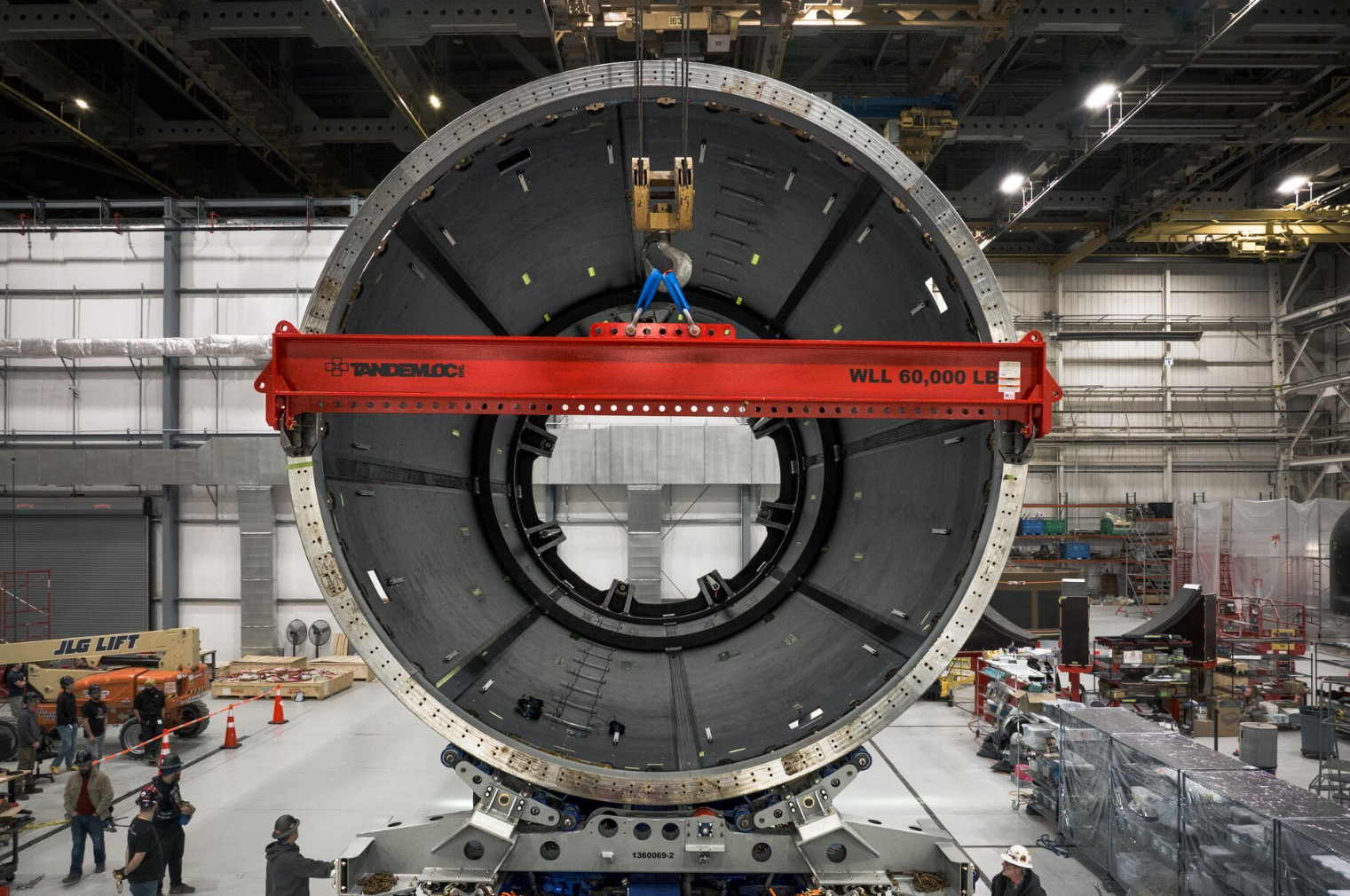
Throughout Rocket Lab’s various facilities, we’re starting to see large structural components of Neutron making progress as the company pushes toward a maiden flight. Most recently, the company showcased the interstage, which is just about ready to begin qualification testing.
In a video from the company, we see teams working with this structure, along with a few other core Neutron sections in the background. Here I will go more in-depth into the recent developments, challenges the company still faces, when to expect a launch, and more.
Neutron’s Structure
A few days ago, on the 13th, Rocket Lab tweeted saying, “Neutron testing continues at our Space Structures Complex in Middle River with the interstage on the test stand ready for its qualification campaign. We’re running a series of static load tests and applying ~1,000 tonnes of force to simulate flight loads on the way to orbit.” In the video, we see teams turning the stage horizontal before placing it on a mobile platform. Reports suggest that it’s already been taken outside and oriented vertically on a test stand. Assuming it holds up, it shouldn’t take too long to complete those qualification tests.
The company was quoted saying, “Neutron’s interstage has to withstand not only the rigors of launch, but also reentry as it remains attached to the vehicle’s first stage and Hungry Hippo fairing, landing back on Earth as one integrated structure ready for the next launch.” Due to Neuturon’s unique design, the interstage is quite a bit longer than what you would see on a typical rocket. With the entire upper stage positioned on the inside of the vehicle, the interstage, in combination with the fairing structure, covers much more than just the engine section, for example. While not the most complex piece of the rocket, it serves a vital role and brings the company one step closer to eventual stacking.
Looking back at the video, if you pause it about halfway through, in the background, you can see what looks like the upper stage. For a while now, Stage 2 has been marked as complete and ready for flight. On the left side, the mounting for an eventual single vacuum-optimized Archimedes engine can be seen. Besides that, the stage is just waiting for the rest of the rocket to finish testing.
In regard to those other parts of the rocket, a few weeks ago in late January the fairing structure arrived in Virginia. Late last year, the fairings completed qualification and were then sent on a long journey to the U.S. from New Zealand. After arriving, teams started their inspections to prepare the fairing for further pre-launch testing at Neutron’s nearby launch and test site, Rocket Lab Launch Complex 3.
In a statement, the company said, “Hungry Hippo’s arrival marks another step toward Neutron’s debut that will usher in a new era of commercial space access. With a launch, return, and launch again ethos that mimics commercial aviation, Neutron will bring innovation and competition to today’s global space industry that strengthens America’s industrial base and ensures its access to space with reliable and modern launch capabilities” they said.
While progress is being made, it’s not without any challenges. Last month, in January, during a pressure test of Neutron’s first stage tank, it ruptured, destroying the stage. Rocket Lab commented, “As the Company pushes Neutron to the limits and beyond to qualify its systems and structures for launch, qualification testing of the Stage 1 tank overnight resulted in a rupture during a hydrostatic pressure trial. Testing failures are not uncommon during qualification testing. We intentionally test structures to their limits to validate structural integrity and safety margins to ensure the robust requirements for a successful launch can be comfortably met,” they mentioned.
Fortunately, there was no significant damage to the test structure or facilities, and the next Stage 1 tank is already in production. That being said, this could cause some delays in the event that other core Neutron structure components are ready and end up having to wait on the first stage.
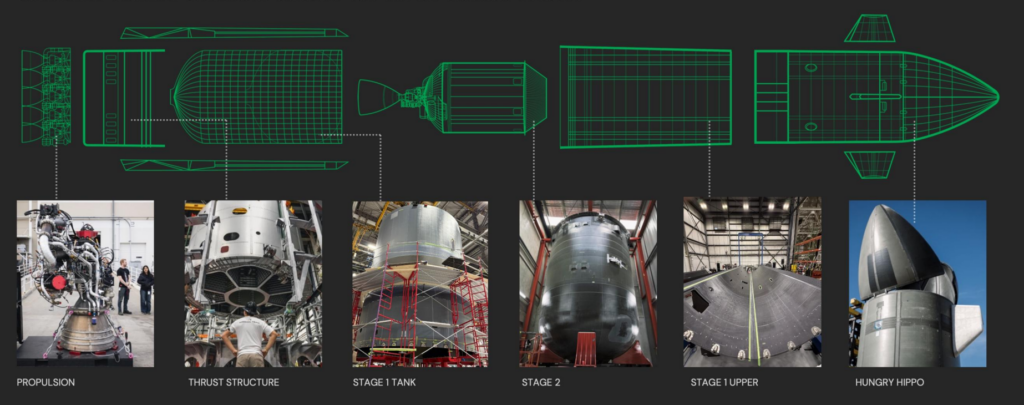
Looking at some images provided by the company, we can get a better idea of what’s being worked on and how it fits together. Starting from the right side, it becomes clear that basically the entire top half of Neturon is nearly complete. As previously highlighted, the fairing structure, interstage, and stage 2 tank are all physically built and require relatively small amounts of extra testing. Besides the interstage structural testing, the next big item would be flight mechanisms testing. This encompasses the fairings, which have to open and close, as well as the control surfaces that are also mounted on this section.
If we move further down the rocket, the work needed starts to increase. The main components here feature the first stage, the thrust structure, and 9 Archimedes engines. We know the first stage was lost, and the next one is in production. You then have the thrust structure, which is one of the more complex pieces of Neutron. Last month, Rocket Lab provided an update on some of the testing they had been doing. They pointed out that this section must be able to withstand 2.1 million pounds of thrust during tests. Images showcase the cutouts for future Archimedes engines, along with landing leg mounting spots on the side. Even with this being one of the most complex parts of the rocket, progress-wise, it looks to be in a good position.
That leads to the very bottom and the production of Archimedes engines, which the first test article will need 10 of. Late last year, it was revealed that the rocket engine manufacturing line was capable of making a new engine every 11 days. This comes in addition to increased and nearly constant testing of Archimedes. There were reports of engines being lost in testing, however, Peter Beck stressed that they are now past the point of nominal testing and are stressing these engines until failure to gather as much data as possible.
The reality is, these engines have been going through an immense amount of testing. To put it in perspective, back in the middle of 2025, Peter Beck was quoted saying, “We’re running the engine to full mission duration, and the operation test cadence is heading up to 3 or 4 hot fires a day now, 7 days a week, as we work diligently through all the engine qualification program.”
At full power, each Archimedes engine is capable of producing 165,000 lbf (733 kilonewtons). Some critical 3D-printed parts that at one point have undergone testing include turbo pump housings, pre-burner and main chamber components, valve housings, and engine structural components. When the company and the two stages are ready for static fires, the engines should be there.
Rocket Lab provides a path to lift off, which can help estimate when they will be ready for launch. Currently, the items marked as in progress include the flight mechanisms test program, engine qualification, stage 1 qualification, regulatory approval, vehicle integration, and stage 2 static fire. The only other items that aren’t marked as in progress are stage 1 static fire, wet dress rehearsal, and launch.
Officially, late last year, Rocket Lab delayed Neutron’s launch and said they were targeting a complete rocket on the pad in the first quarter of 2026, with a launch soon after. Based on current progress and considering how ambitious the Neutron program is as a whole, realistically, we won’t see a launch until late this year or early 2027. In a few weeks, Rocket Lab is set to report its fourth-quarter and full-year 2025 financial results. Included in that will likely be a new updated launch estimate for the rocket, saying mid to late this year.
The reality is developing a rocket like Neutron for the first time is going to take longer than expected, and that’s assuming there are no major setbacks. On the bright side, the company is making substantial progress and getting closer to that eventual launch.
Things like the launch pad are ready and waiting for Neutron to arrive. Late last year, they unveiled the pad with its finished launch mount and supporting infrastructure. The mount is 9 m (~30 ft) tall and contains over 700 tons of steel, operated by hydraulic mechanisms that support, hold, and subsequently release Neutron for test and launch operations. Within this structure is also the water deluge system, which alone weighs close to 180 tons. This system, which we’ve seen tested not only when it was first installed but also after the mount was completed, sprays massive amounts of water under the rocket right before and during first-stage engine ignition. Its purpose is to help suppress the intense sound and heat generated by Neutron’s 9 Archimedes engines. There’s also a trench and additional concrete to help protect the site and direct the rocket’s exhaust over the water.
You then have 180,000-gallon LOX and LNG propellant farms that store and load Neutron with fuel and oxidizer for test and launch operations, alongside 45,000 gallons of stored liquid nitrogen in three vertical tanks. These different propellant storage tanks can be seen on either side of the pad, primarily in the long horizontal tanks. Combine this with work on the landing barge, and it’s clear that future Neutron flights are getting closer.
Conclusion
Rocket Lab has been busy as they work to get Neutron ready for its first flight. While it hasn’t been without any setbacks, they are pushing forward, and some of the main structural components are either done with testing or starting qualification testing. In the coming weeks, we can expect more information from the company along with updated launch estimates.