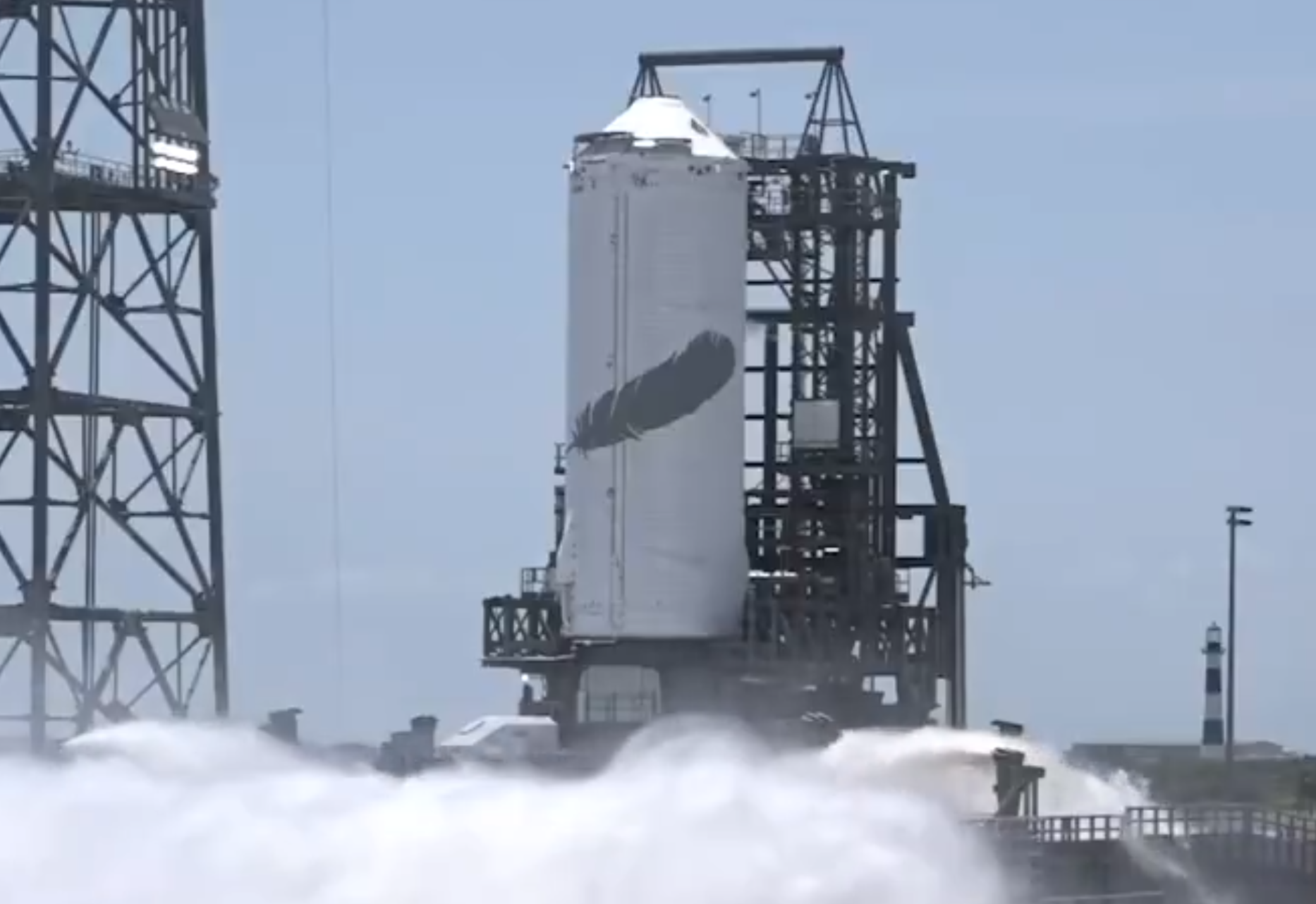
In only a few weeks from now, we can expect the second New Glenn rocket to roll to the pad for testing and then launch. Over the past few days, Blue Origin has shared new info and videos of the second booster, which is nearly complete.
It only needs a few more BE-4 engines installed, followed by some of the finishing steps, before it’s ready to integrate with the upper stage and begin pre-launch milestones. The last New Glenn launch’s core mission was successful; however, they weren’t able to land the booster downrange on a landing vessel, something they are hoping to change this time around. Here I will go more in-depth into the recent progress, final steps, launch timeline, and more.
Booster Prep
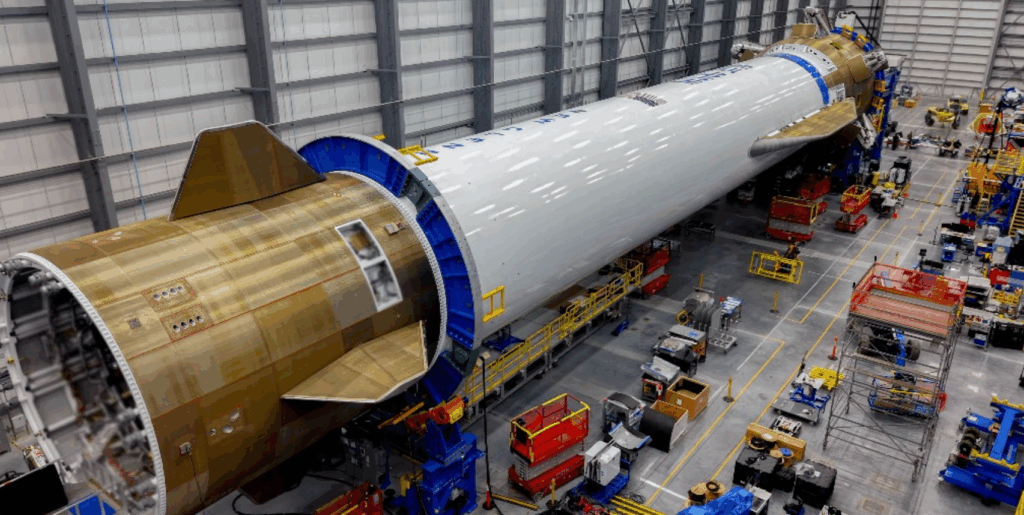
Starting a few days ago on the 26th, Blue Origin shared an image of the booster within their facility and highlighted that this first stage is headed to LC-36 in early October. Once arriving at the pad, they expect the hotfire to occur around the middle of that month with a launch soon after.
Timeline-wise, on the first New Glenn launch we saw the booster static fire in late December and then the launch in the middle of January. In other words, it took a bit over two weeks between that mission milestone and launch. Assuming a similar schedule for this upcoming mission, if they complete the static fire successfully in the middle of October, we could see the launch happening around late October to early November. That being said, the last launch was the maiden flight of New Glenn, so Blue Origin could be much faster this time around.
In addition to images, we got some video of the booster. Blue Origin named this second booster, “Never Tell Me The Odds” in reference to its upcoming landing attempt. On the first flight, the booster was named “So You’re Telling Me There’s A Chance”, keeping up with the theme.
Dave Limp, the CEO, commented, “I think the odds of landing this booster are a lot better than 3,720-to-1. Both strakes are in place, and BE-4 installation is well underway. Great job by the team as we continue getting our second booster ready for launch” he said.
Looking at the booster, you can see that, similar to the last flight, parts of it remain unpainted. These areas include the interstage, strakes, and aft section. Specifically, each of those areas is covered by what Blue Origin calls Comet, which is a thermal protection system. Originally, on practically all New Glenn renderings, most of these thermal-protected areas were painted white, with the exception of the aft module, which was painted a dark grey. When asked about the lack of paint Dave Limp mentioned, “We could—but have chosen not to for a variety of reasons, including adding unnecessary weight.”
Just like the first launch, they’ve gone that same route, meaning we can expect future New Glenns to look just like this as well.
Besides the booster, other parts of the vehicle have been busy in preparation for the launch. Back in April, they completed a 15-second hotfire with New Glenn’s upper stage, or GS2 serial number 2. The test served as a final validation that the vehicle is working as intended. In August, they hot-fired serial number 3. They also mentioned that by now the next upper stage (serial 4) is not far from being done.
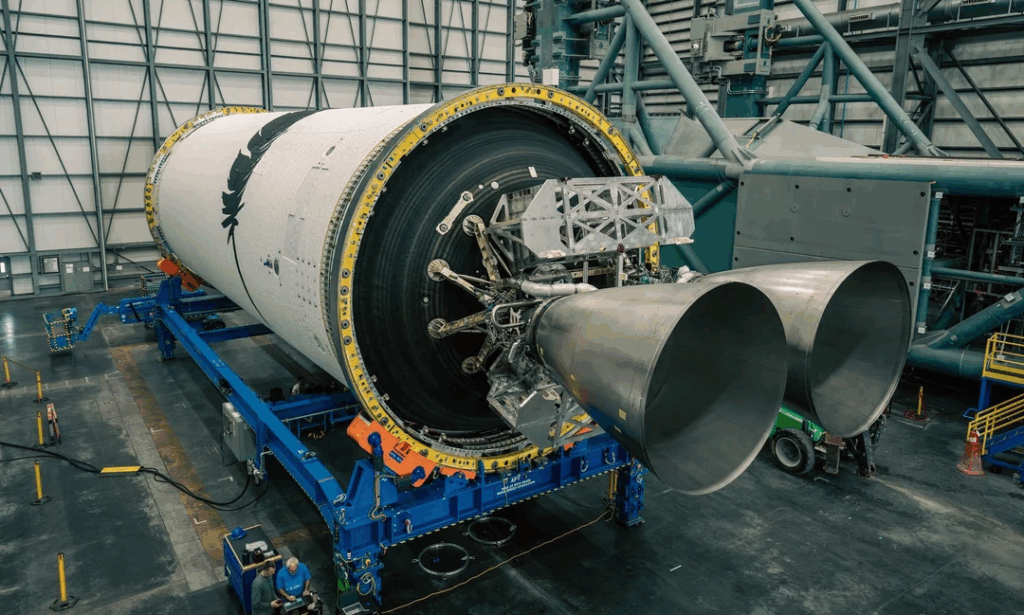
The BE-4 engines, which New Glenn uses 7 of, have also been an important production-related item. Back in July of this year, all 7 engines were just about ready and waiting for the vehicle. This is a good sign as the demand for BE-4 engines is only expected to increase in the future.
Besides the upper stage hot fire, the company has already finished work with the interstage RCS thrusters and fins. In one test, they activated the hydrogen peroxide system that fuels the Reaction Control System. The first stage RCS provides 20,000 lbf thrust in any direction, allowing the first stage to reorient itself in space before re-entry and to precisely target Jacklyn in high winds during landing. They also highlighted that during the first New Glenn launch, the RCS performed nominally and successfully reoriented GS1 to within 0.5 deg of its target attitude during exo-atmospheric flight.
Lastly, there was testing of the aft section. This test activates the hydrogen peroxide system that powers the aft module hydraulics and conducts a shortened mission simulation of the integrated system. The four auxiliary power units, or APUs, produce a combined peak of 1,000 horsepower to drive the hydraulic pumps. Not long after this step was finished they began installing the seven BE-4 engines.
This leads to now, with a few finishing touches needed before an expected rollout and static fire in the middle of October, followed shortly after by a second launch.
Flight Profile
One of the reasons this second flight is significant has to do with the payload. On the first flight, they launched one of Blue Origin’s own spacecraft, the Blue Ring Pathfinder. Not only was it their own, but it was mainly a demonstration meant to test its in-space telemetry, tracking and command hardware, to then be used on future Blue Ring production.
This time around, New Glenn is set to launch a much more significant payload, in the form of two spacecraft headed for Mars. The Escape and Plasma Acceleration and Dynamics Explorers (ESCAPADE), in partnership with NASA, will use two identical spacecraft to investigate how the solar wind interacts with Mars’ magnetic environment.
Rocket Lab is also involved, as they are the ones who designed and built the twin spacecraft over the last three and a half years, called Blue and Gold. Just days ago, these spacecraft arrived in Florida. Once deployed from New Glenn’s second stage, they’ll begin a 22-month cruise to Mars. Blue and Gold will travel together before entering complementary elliptical orbits around the planet to conduct their science campaigns. The spacecraft will simultaneously capture data from two regions of Mars’ magnetosphere. This two-point measurement will allow scientists to understand how the solar wind strips atoms from Mars’ atmosphere, offering insight into the planet’s atmospheric escape history and space weather environment, and informing future human exploration strategies.
This was actually supposed to be on New Glenn’s first launch. In that case, after confirming it wouldn’t launch on the maiden flight, the agency said, “The decision was made to avoid significant cost, schedule, and technical challenges associated with potentially removing fuel from the spacecraft in the event of a launch delay, which could be caused by a number of factors.” Fortunately, it worked out to move the ESCAPADE launch to the second flight.
Between now and vehicle integration, Rocket Lab engineers will conduct post-transport inspections and functional tests in the cleanroom before finally loading propellant. Once everything is complete and ready, they will be placed within New Glenn’s fairings.
In terms of the mission profile, again, we will see an attempted booster landing downrange. After flight 1, the FAA completed its mishap investigation following the loss of the booster. They were quoted saying, “The FAA oversaw and accepted the findings of the Blue Origin-led investigation. The final mishap report identified the proximate cause of the mishap as an inability of New Glenn’s first stage to restart the engines, preventing a reentry burn from occurring, and resulting in the loss of the stage. Blue Origin identified seven corrective actions to prevent reoccurrence of the event. The FAA will verify that Blue Origin implements corrective actions prior to the launch of the New Glenn-2 mission” they said.
Blue Origin was a bit more specific, commenting, “Our ambitious attempt to land the booster, “So You’re Telling Me There’s a Chance,” was unsuccessful due to our three BE-4 engines not re-igniting properly. On New Glenn, three of the seven engines gimbal to provide the control authority during ascent, re-entry, and landing on Jacklyn, the recovery vessel located downrange at sea. That gimbal capability, along with the landing gear and Reaction Control System thrusters, are key to making the booster fully reusable.
While landing on the second attempt is still ambitious, the company definitely gained a lot of valuable flight data from the first launch that they’ve applied to the second vehicle. Also, with launch cadence expected to increase in the near future, the sooner they start reusing boosters, the better.
The program has several vehicles in production and multiple years of orders. Customers include NASA, Amazon’s Project Kuiper, AST SpaceMobile, and several telecommunications providers, among others. Blue Origin is working to certify New Glenn with the U.S. Space Force for the National Security Space Launch (NSSL) program to meet emerging national security objectives.
Back in April, Blue Origin won a contract to serve as a National Security Space Launch (NSSL) Phase 3 Lane 2 heavy-lift provider. This contract tasks New Glenn with missions to stressing orbits requiring higher performance launch systems and full mission assurance as a Space Systems Command certified launch vehicle. It’s the third national security launch-related contract they’ve been awarded in the past year. All of which benefit from what the company hopes is a successful second flight.
Conclusion
In the coming weeks, we can expect the second New Glenn to roll to the pad and go vertical. It will then complete a static fire of the first stage, and if everything goes as planned, we can expect the launch to take place around late October.