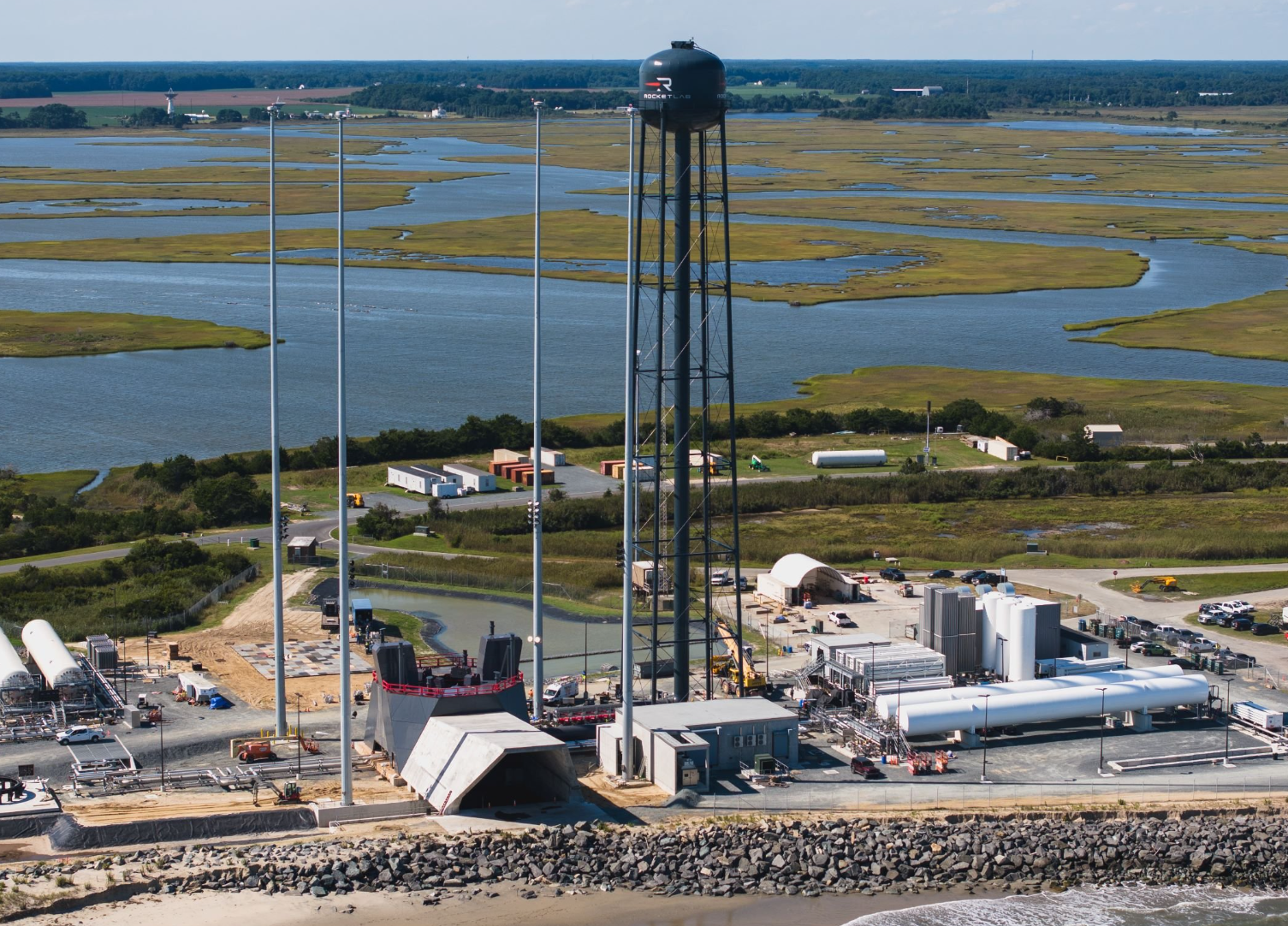
After around two years of construction, Launch Complex 3, a site made specifically for Neutron operations, is now ready to support the vehicle’s maiden flight. Late last month, Rocket Lab officially cut the ribbon and celebrated the site’s opening.
On the pad is a significant amount of infrastructure, including a massive launch mount, water deluge system, and propellant storage, just to name a few. With this, they are hoping to start supporting final pre-launch testing and then the maiden flight by the end of this year. Here I will go more in-depth into the site’s infrastructure, its importance, the progress on Neutron, and more.
Pad Infrastructure

Rocket Lab has made multiple launch complexes in the past; however, those sites were made for the company’s Electron rocket, which is a small lift launch vehicle. The new pad is made for Neutron, a partially reusable medium lift launch vehicle. Not only is it much bigger, requiring more propellant, a larger mount, etc, but it’s also significantly more powerful. To put it in perspective, the Electron rocket at liftoff produces 43,000 lbf, whereas Neutron will produce nearly 1,500,000 lbf when lifting off the pad.
In order to accommodate this increase in size and especially power, Rocket Lab had to design a launch complex capable of supporting a new type of rocket. During the nearly two years of construction, more than 60 contractors were involved in the site’s development to supply services, hardware, and materials.
Looking at the site itself, the most obvious and main component is the launch mount. The mount is 9 m (~30 ft) tall and contains over 700 tons of steel, operated by hydraulic mechanisms that support, hold, and subsequently release Neutron for test and launch operations. Within this structure is also the water deluge system, which alone weighs close to 180 tons. This system, which we’ve seen tested not only when it was first installed but also after the mount was completed, sprays massive amounts of water under the rocket right before and during first-stage engine ignition. Its purpose is to help suppress the intense sound and heat generated by Neutron’s 9 Archimedes engines. There’s also a trench and additional concrete to help protect the site and direct the rocket’s exhaust over the water.
You then have 180,000-gallon LOX and LNG propellant farms that store and load Neutron with fuel and oxidizer for test and launch operations, alongside 45,000 gallons of stored liquid nitrogen in three vertical tanks. These different propellant storage tanks can be seen on either side of the pad, primarily in the long horizontal tanks.
Besides the launch mount and propellant tanks, there are also various structures spread across the launch complex. These are mainly different launch equipment vaults that house electrical and control equipment needed to operate the site’s ground systems and launch vehicle. Lastly, there’s the massive 200,000+ gallon capacity water supply tower standing at over 200 ft (61m) tall.
Altogether, this infrastructure is now ready for Neturon flight hardware to make its way to the pad and launch. Based on the current progress and path to liftoff, the first use of the pad will likely be a wet dress rehearsal and static fire of the vehicle.
Interestingly, even though the site is ready to begin operating, it’s not actually done yet. The lead Ground Systems Engineer at Rocket Lab was quoted saying, “There are quite a few block upgrades that are planned for Launch Complex 3. Most notably, you’ll see block upgrades to the lifting and integration infrastructure on the launch site itself. In addition to that, you’ll see a doubling of propellant storage and a number of other assets put in place to support rapid turnaround times for both test opportunities as well as missions” he said.
That first comment he mentions lifting and integration infrastructure. In other words, currently, the site doesn’t have a permanent way of lifting stages on and off the launch mount. In the lead-up to Neutron’s maiden flight, we can expect the company to move a crane over and lift the stages that way. In the future, however, we could see a more permanent tower or structure in place to help speed up and streamline that process. The other point he made was about doubling the propellant storage in addition to other assets. With Neutron being partially reusable, Rocket Lab has made it clear that the goal is to increase the launch cadence quite substantially. In order for that to happen, future upgrades to Launch Complex 3 make sense for the company.
Launch Complex 3 is Rocket Lab’s fourth launch site, and is located directly next to Rocket Lab Launch Complex 2, the Company’s exclusive-use orbital launch pad for its Electron launch vehicle. At this point, the new pad stands ready to deliver the largest orbital launch capacity in the Spaceport’s history with Neutron: a vehicle capable of launching 13,000kg (33,000 pounds) to space for commercial constellations, national security, and interplanetary missions, and eventually human spaceflight.
In response to the site’s progress and official opening, Rocket Lab’s CEO Peter Beck was quoted saying, “Launch Complex 3 is our commitment to providing assured access to space and the launch site diversity that’s needed in the United States for its most important missions. Our Neutron rocket, with its ability for responsive space access as a high cadence reusable launch vehicle, expands Virginia’s aerospace capabilities to enable the United States to quickly and reliably reach the International Space Station and low Earth orbit, as well as explore beyond Earth and on to the Moon and Mars.”
“Together with the Commonwealth of Virginia, VSA, and NASA, we’re strengthening the nation’s leadership in space while creating new opportunities for innovation and growth in the state and beyond, and I’m thankful for their continued support of Rocket Lab in Virginia” he said. It’s clear the company is very excited about this milestone and eager to get actual test hardware on the pad.
Upcoming Testing

With the pad ready, Rocket Lab is now working to get Neutron stages ready for final testing. Looking at the path to liftoff, some of the items still marked as in progress include the flight mechanisms test program, engine qualification, stage 1 qualification, regulatory approval, vertical integration, and the stage 2 static fire. The only two other items are a stage 1 static fire and a full rocket wet dress rehearsal. Those final two steps will need to be completed at the pad and are likely to happen right before the launch.
While ambitious, the company is still aiming to launch Neutron at the end of this year. In a recent statement, Peter Beck commented, “All in all, we continue to push extremely hard for an end-of-year launch. We continue to run a greenlight schedule with Neutron, which means every single thing needs to go to plan for the schedule to hold. But I also want to stress that we’re not going to rush and take stupid risks to launch Neutron before it’s ready. What’s really important is performance, reliability, scalability, right from the get-go. There will be no cutting corners here to just rush to the pad for a deadline” he said.
In many ways, we are seeing progress speed up. It was recently revealed that the rocket engine manufacturing line is now capable of making a new engine every 11 days. This comes in addition to increased and nearly constant testing of Archimedes.
The overall challenge for Rocket Lab is creating a brand-new type of launch vehicle that in many ways is very unique. The medium-lift Neutron rocket is a next-generation challenger aiming to deliver a cost-effective, reliable, and responsive launch service for commercial and government missions. The design of Neutron includes carbon composite for all of the rocket’s major structures and an innovative upper stage that aims to enable high performance for complex satellite deployments, including the deployment of satellite mega-constellations.
Rocket Lab highlights that “The Neutron launch vehicle is a reusable launch vehicle leveraging the technology and infrastructure pioneered by the Electron launch vehicle, which has launched 70 times to date and provides the U.S. government and commercial customers frequent, affordable access to space.”
On an actual mission, Neutron will utilize a design that brings the Stage 1 and payload fairings back to Earth as a single, integrated stage in order to try and maximize cadence in a 13-ton to orbit reusable performance capability. It’s powered by nine Archimedes engines on Stage 1, and one vacuum-optimized Archimedes engine on Stage 2.
When we do eventually see Neutron on the pad and ready for flight, the first launch should look a bit different than the end goal. For example, we know that on the maiden flight, they will not be attempting to land the booster. Instead, we can expect a soft water splashdown, assuming everything goes as planned.
Eventually, this will lead to landing attempts on a landing barge. Back in February of this year, Rocket Lab shared some of the first images and information on its newly acquired ship. The massive barge is 400 ft (122 m) long and named Return On Investment.
They also announced that they awarded a contract to the largest privately owned new construction and repair shipbuilder in the United States to support the build-out of Rocket Lab’s ocean landing platform. Currently, delivery of the vessel is expected in early 2026.
In the future, Rocket Lab expects to quickly scale Neutron and double its launch capacity annually once it enters service. In order to do this successfully, they need to be landing boosters and bringing them back for refurbishment, which is where the landing vessel comes in. Once complete, the ship will be operated out of the U.S. East Coast to support the timely delivery and return of Neutron rockets to its launch site on Wallops Island, Virginia.
Conclusion
The Neutron Launch Pad is ready for final testing and the first launch of Rocket Lab’s new medium-lift launch vehicle. A much larger mount, propellant storage, and supporting systems all combine to create Launch Complex 3. While more upgrades and additions are already planned for the future, at its current state, it’s capable of launching and testing Neutron.