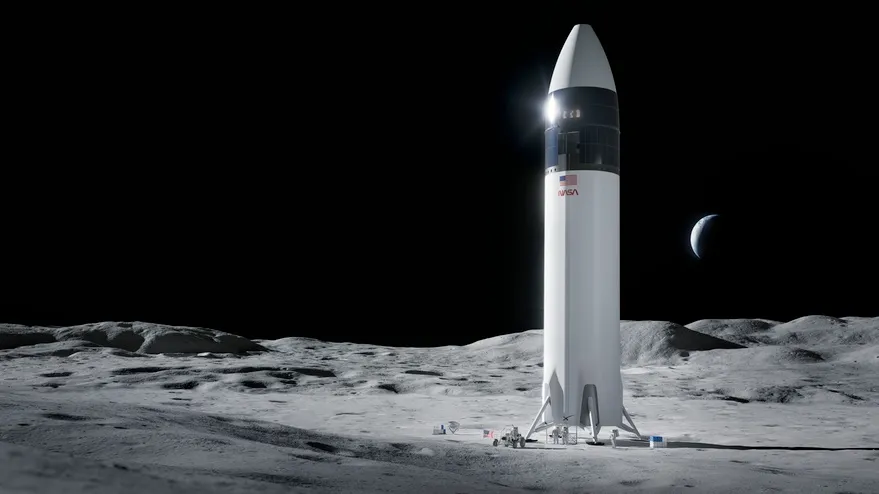
Just a few days ago, a new report was released that, among other projects, went over the Starship Human Landing System, a lunar variant of Starship hoping to land humans on the Moon in the relatively near future. Despite some of the recent test flights which have ended earlier than hoped, the report finds that SpaceX is still on schedule.
That being said, that determination is under the assumption that the company completes some significant milestones by the end of this year.
A Busy Future
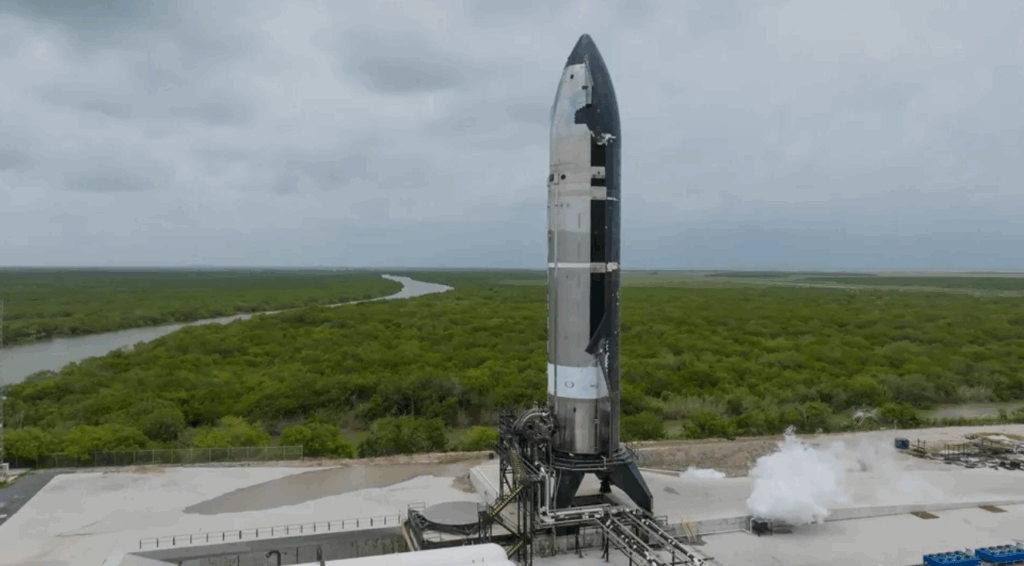
The plan for the Human Landing System (HLS) is to create a lunar Starship variant that will be used as a transportation system to the moon, providing crew access to the lunar surface and demonstrating initial capabilities required for deep space missions. NASA plans to use the HLS initial capability for the Artemis III mission to the moon.
The recent report was from the GAO, or Government Accountability Office. Within it, they determined that “The HLS Initial Capability project is operating within the cost and schedule baselines NASA established for the project in December 2023.”
They go on to say, “SpaceX conducted three successful flights of the Starship between June 2024 and November 2024. Two separate flights in January and March 2025 were not successful.”
Looking at the timeline provided, it showcases some major milestones expected to be completed within the next 6 months. Besides propellant transfer, they point out an uncrewed lunar landing test flight set for this year as well as an upcoming review. Specifically, they say, “SpaceX held an SLD certification baseline review in May 2023 and is working toward its preliminary design review in August 2025.” SpaceX and NASA also plan to hold the HLS Initial Capability critical design review this year.
Importantly, a lot of the major milestones are directly correlated with the active test program and Starship flights. Even though they determined the project is still on schedule, they highlighted a few possible concerns. In one quote, they say, “One of the top risks facing the program is maturing propellant management technologies to support on-orbit storage and transfer of propellant. SpaceX plans to demonstrate the required systems during ongoing flight tests” they said.
Obviously, this development and testing require the upper stage to perform much better than the last few test flights. Not to mention, it’s also quite complicated. At the recent Starship Mars presentation, when talking about ships transferring propellant, Elon was quoted saying, “The two Starships would get together, one Starship would transfer fuel and oxygen. Most of the mass is oxygen, it’s almost 80% oxygen that gets transferred, a little over 20% fuel. This is an important technology, which we should hopefully demonstrate next year,” he said.
SpaceX’s plan for landing astronauts on the moon requires multiple interactions between different vehicles in space. The first involves an on-orbit propellant transfer from multiple tanker Starship vehicles to a depot Starship vehicle in low-Earth orbit. Once the depot accumulates sufficient propellant, the HLS Lander will launch and dock with the depot for a propellant transfer before docking with the Orion spacecraft in lunar orbit. In the report, they mention, “As part of its test campaign, SpaceX is planning a flight to demonstrate ship-to-ship cryogenic propellant transfer in 2025, followed by an uncrewed lunar landing demonstration.”
This contradicts statements and timelines recently shared by Musk and highlights how fast schedules are changing depending on the success of flight tests, among other factors. Around the time of this report being created and published, the 9th test flight of Starship hadn’t occurred yet. With the upper stage losing attitude control and preventing some of the mission milestones, it no doubt impacts the overall HLS timeline. When you consider that a ship propellant transfer realistically won’t happen until next year at the earliest, this also pushes back an uncrewed landing attempt into 2026 or later.
In the report, they later say, “NASA is tracking a risk that some of the necessary propellant management technologies or capabilities will not be adequately matured as planned. According to NASA documentation, this could impact the project’s ability to verify and validate the SpaceX lunar mission architecture, resulting in delays to the Artemis III mission.”
All that being said, it really comes down to upcoming test flights and getting Starship V2, and not long from now, V3 up and running, and surviving the entire mission profile. In the future, once the critical design review takes place, we’ll get a much more in-depth idea of how the program is developing and what steps are left before an uncrewed lunar landing. Between now and then, we can also expect more test flights, which hopefully will also paint a better picture.
Cost & Development

Besides the schedule, there’s also the cost side of things. Within the report, they note that “The HLS Initial Capability project is operating within the cost and schedule baselines that NASA established for the project. The project’s first operational flight will support the Artemis III mission. NASA tied the HLS Initial Capability schedule baseline to a lunar orbit checkout review in February 2028. The lunar orbit checkout review will examine the readiness of the HLS Starship to perform the Artemis III mission and receive crew from the Orion spacecraft.”
Specifically for price, NASA set the HLS Initial Capability baseline life-cycle cost at about $4.9 billion. These baselined costs cover the effort through the post-mission assessment review. In December 2024, NASA announced delays to both the Artemis II and Artemis III missions. NASA attributed these delays to several causes, including technical challenges with the Orion capsule heat shield and batteries. NASA’s current schedule for the Artemis III mission is now mid-2027. The HLS project is assessing the impact of the delay of the Artemis III mission. In one final quote, they said, “Officials told us that as part of this process, they plan to begin updating associated schedules and negotiating contract modifications with SpaceX.”
In other words, the Artemis missions involve many more moving pieces than just the Human Landing System, and as a result, delays are occurring with projects not even necessarily involved with the Starship Lunar variant.
To add to that, NASA is also tracking a risk related to the adequacy of facilities available to teach astronauts how to manually control the HLS and to condition them to flight-like conditions anticipated during descent and landing on the lunar surface. They point out that “The HLS Initial Capability concept of operations requires the crew to be capable of performing a manual landing in some scenarios. This will require a mastery of certain skills, including an understanding of the vehicle dynamics. NASA is concerned that the planned training facilities do not have the capability to train the crews to a mastery level. This could result in an increased probability of loss of the vehicle, crew, and mission during the landing phase. NASA plans to better define the training requirements by the program critical design review, currently scheduled for some time in 2025.”
They are also tracking a risk related to inadequate controls for flammable materials. They note that “The amount of oxygen and cabin pressure in the SLD lander atmosphere could create conditions for fire propagation, potentially resulting in loss of mission or crew. The project is conducting tests to better understand material flammability in the lander and techniques to prevent fires from starting and spreading” they said.
For context, the HLS is meant to deliver crew from lunar orbit to the lunar surface, provide capabilities for lunar surface extravehicular activities, and then return the crew and materials to lunar orbit to enable their return to Earth. As part of this mission, the HLS will dock with the Orion Multi-Purpose Crew Vehicle (Orion) in lunar orbit.
Once the crew and their supplies are ready, two astronauts will board Starship and two will remain in Orion. Orion will undock and back away from Starship to remain in NRHO for roughly one orbit around the Moon, lasting about 6.5 days. This will match the length of the surface expedition, so as Orion completes its orbit, the two person surface crew will finish their work on the surface in time to launch back up to meet the spacecraft.
NASA has its sights set on locations around the South Pole for the Artemis era of human lunar exploration. Using autonomous systems, the crew inside of Starship will land at a carefully selected site within a 100-meter radius.
During their time on the Moon, the astronauts will do scientific work inside Starship and conduct a series of moonwalks, exiting Starship to explore the surface. When their surface expedition is complete, the two astronauts will lift off the surface of the Moon and head back to NRHO in Starship to reunite with their crewmates in Orion. After docking, the crew will spend up to five days in orbit, transferring samples between the vehicles and preparing for the journey back to Earth.
With deadlines closing in, the faster SpaceX solves Starship V2’s problems or moves on to V3, the better. Each future test flight has at least some impact on the overall schedule, mainly related to a propellant transfer demo and some of the mission milestones. As for flight 10, it was scheduled as soon as late last month before the loss of the upper stage on the test stand. At this point, it likely won’t happen until around August, assuming testing goes as planned.
Conclusion
In a recent report from the GAO on the Artemis program, they determined that SpaceX’s Starship HLS was on schedule. That being said, it was based on ambitious dates that have since changed, such as a propellant transfer demo this year, which in reality won’t happen until 2026 at the earliest. The upcoming test flights of the vehicle will have the biggest impact on schedule.